
Weird Facts About Plants That Seem Impossible
Nature · 8 min read · 9/15/2026
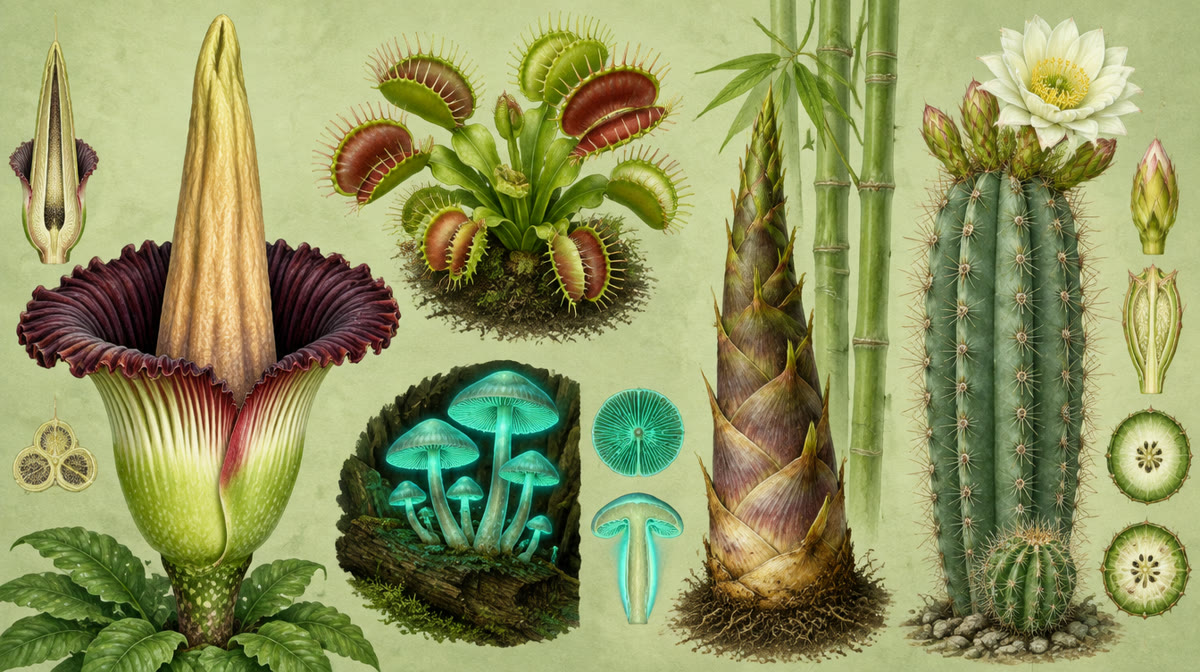
Plants lack brains, muscles and nervous systems in the form animals have, yet research increasingly shows they respond to their environment with surprising sophistication. Some behaviours once assumed to require animal-level complexity turn out to have plant equivalents, achieved through entirely different biological mechanisms.
The Venus flytrap can count
The Venus flytrap's trap only closes after tiny trigger hairs are touched at least twice within about twenty seconds, a mechanism that helps the plant avoid wasting energy on false alarms like a falling raindrop. Research has shown the plant essentially counts stimulation events before committing to a full digestive response, becoming more active with additional touches.
- A Venus flytrap's trap can snap shut in roughly one tenth of a second.
- The plant is native to a small native range in the Carolinas of the United States.
- Digestive enzymes are released only after sufficient triggering confirms live prey is present.
- Each trap can only close a limited number of times before losing its ability to function.
Trees can communicate through underground networks
Many trees form symbiotic relationships with mycorrhizal fungi, which connect root systems into extensive underground networks sometimes informally called the 'wood wide web.' Through these connections, trees can share nutrients and transmit chemical distress signals warning neighbouring trees about insect attacks or other stresses.
A forest is not simply a collection of separate trees; it can behave like a connected, resource-sharing community below the surface.
Some plants mimic animals for survival
Certain orchid species have evolved flowers that closely resemble female insects in shape, colour and even pheromone scent, tricking male insects into attempting to mate with the flower and inadvertently transferring pollen in the process. This strategy, called sexual deception, is a highly specialized form of pollination evolution.
Plants respond to being eaten
When attacked by herbivores, many plants release volatile chemical compounds that can attract predators of the herbivore itself, effectively calling in help. Some plants also increase production of bitter or toxic compounds in their leaves after initial damage, making continued feeding less appealing to the attacking insect.
- The corpse flower produces a smell resembling rotting flesh to attract carrion-feeding pollinators.
- Mimosa pudica, the sensitive plant, rapidly folds its leaves when touched as a defensive response.
- Some seeds can remain dormant but viable in soil for many decades before germinating.
- Certain desert plants can survive extended drought by dramatically reducing their own metabolic activity.
Reconsidering what plants can do
These behaviours do not suggest plants possess consciousness in any way comparable to animals, but they do demonstrate that complex, adaptive responses to environmental information do not require a brain. Plant biologists continue to study exactly how these signalling and response systems operate at a cellular level.
The more closely scientists examine plant behaviour, the more it challenges assumptions that sophisticated response to environment requires the kind of nervous system animals rely on.
Shop this topic on Amazon
As an Amazon Associate we earn from qualifying purchases.
Test yourself on this topic
Animals · 12 questions
Animal Oddities Quiz: 12 Facts That Sound Made Up
Twelve questions about record breakers, strange defences and animals whose reputations are entirely wrong.

Nature · 12 questions
National Parks Quiz: Landscapes, Wildlife and Firsts
Geysers, canyons, rainforests and the world's oldest protected parks. Twelve questions.
Comments
Share your score, argue with a question or add a fact we missed. Comments are checked before they appear, and links are removed automatically.
- No comments yet. Be the first.