

Why Animals Eat Raw Meat While Humans Get Sick
Animals · 7 min read · 11/2/2026
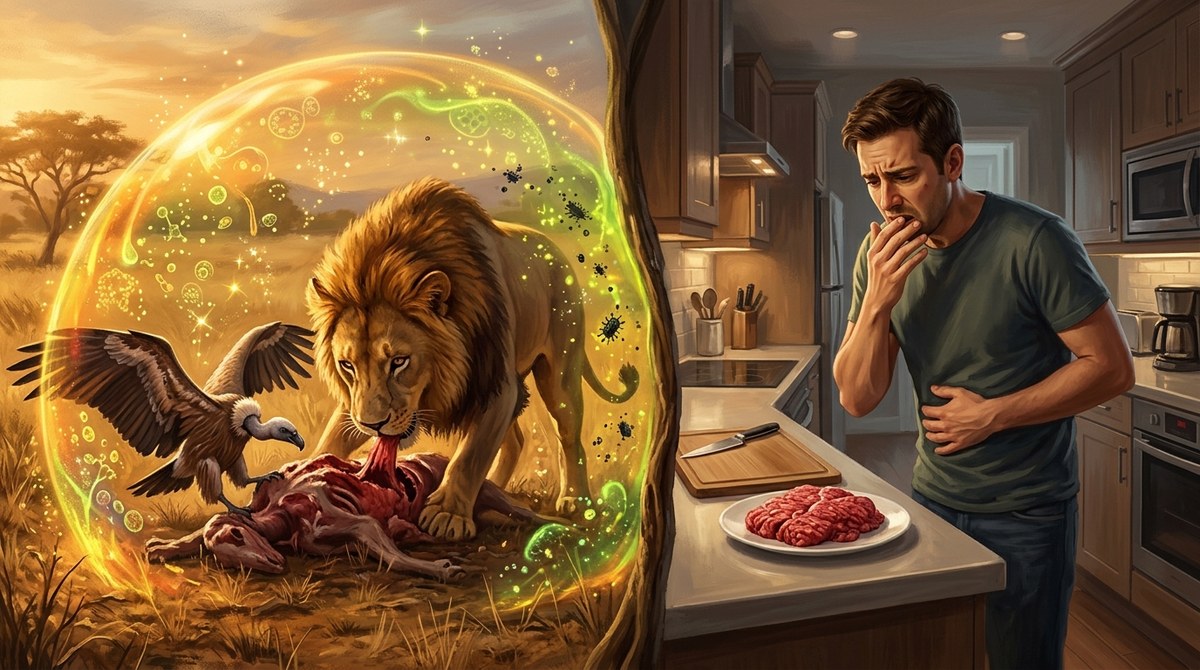
AI-generated editorial illustration, not a documentary image.
Animals can eat raw meat, and even each other alive, because their digestive systems are built for it: stronger stomach acid, shorter and simpler guts, and meals that are usually minutes old rather than days old. Humans lost much of that equipment as we shifted to cooked, prepared food, so the same raw steak that a lion swallows without consequence can leave us with a serious bout of food poisoning. The difference is not willpower or toughness. It is anatomy, chemistry and freshness.
That said, the popular version of this idea overshoots. Wild animals do get sick from what they eat, and some die from it. What they have is a stack of adaptations that tilt the odds heavily in their favor, plus an evolutionary willingness to accept losses that no human health system would tolerate. Here is how the stack actually works.
The stomach is a chemical filter
A landmark 2015 study in PLOS ONE compared stomach acidity across dozens of mammal and bird species and found a clear pattern: the riskier the diet, the stronger the acid. Scavengers and carnivores run significantly more acidic stomachs than herbivores, and the researchers argued that one of the stomach's main jobs is acting as a filter that kills incoming microbes before they reach the intestines.
Vultures sit at the extreme end of that scale. Their stomach acid is corrosive enough to destroy many of the pathogens found in rotting carcasses, including bacteria that would be dangerous to most other animals. Some vulture species can even dissolve bone. This is why vultures function as nature's cleanup crew: pathogens that enter a vulture often die there instead of being passed on through its droppings.
Fresh kills are safer than stored meat
Timing matters as much as anatomy. A lion eating a zebra it just brought down is consuming meat that is minutes old, before bacteria have had time to multiply. The raw meat in a human kitchen has usually been slaughtered, processed, packed, shipped and refrigerated over days. Every hour in that chain is an opportunity for bacteria like Salmonella, E. coli and Campylobacter to grow, which is why food safety agencies set strict cooking temperatures for humans but no lion has ever needed a meat thermometer.
Carnivores also tend to avoid the parts of prey most likely to be contaminated, such as the digestive tract, and their own digestive tracts are shorter and smoother than those of omnivores and herbivores. Food moves through quickly, giving any surviving bacteria less time to multiply to dangerous levels before being expelled.
Scavengers have extra layers of defense
A systematic review in the Journal of Wildlife Diseases examined eight proposed explanations for how carrion eaters avoid sickness and found the strongest support for two: enhanced immune defenses and very low stomach pH. There was also supportive evidence for specialized gut microbiomes and for simply avoiding the most rotten food when fresher options exist.
| Factor | Wild carnivores and scavengers | Humans |
|---|---|---|
| Stomach acidity | Extremely low pH that kills many pathogens | Less acidic; a weaker microbial filter |
| Gut length | Shorter and simpler; bacteria pass through fast | Longer; more time for bacteria to multiply |
| Meal freshness | Usually eaten within minutes of the kill | Days of processing, transport and storage |
| Immune system | Adapted to constant pathogen exposure | Adapted to cooked, prepared food |
| Microbiome | Specialized gut bacteria help suppress invaders | Less equipped for heavy pathogen loads |
Interestingly, the review found no solid evidence for some popular explanations, such as the idea that a vulture's bald head is hygienic or that eating quickly reduces disease risk. The science points to chemistry and immunity doing the real work.
Cooking changed the human body
Humans did not always eat this way, and our biology shows it. Once our ancestors began cooking food, several things happened: cooking kills pathogens, softens tough fibers and unlocks more calories, and over evolutionary time the human gut became smaller and less specialized because the food arriving in it was already partially processed. We effectively outsourced part of digestion to fire and, later, to refrigeration and food safety regulation.
The trade-off is that a modern human gut is poorly equipped for a sudden load of raw, microbe-rich meat. Cultures that do eat raw meat dishes, such as steak tartare or certain cured and fermented preparations, rely on extremely fresh sourcing, careful handling or processing steps like freezing and fermentation that reduce risk. Even then, health agencies treat these dishes as higher risk than cooked equivalents.
Animals are not invincible either
- Wild carnivores do contract foodborne illness and parasites; it is part of the cost of their diet.
- Scavengers prefer fresher carcasses when they can get them; rotten food is a last resort, not a treat.
- Young, old and weakened animals are far more vulnerable to pathogens than healthy adults.
- Domestic dogs and cats can and do get sick from contaminated raw meat, which is why vets caution about raw pet diets.
- Evolution accepts casualties: a wild population can persist even if some individuals die from a bad meal.
Species feeding either on carrion or on organisms that are close phylogenetic relatives should require the most restrictive filter, measured as high stomach acidity, as protection from foreign microbes.
The short answer
Animals eat raw meat safely because evolution equipped them for it: acid strong enough to sterilize a meal, guts that rush food through, immune systems trained by constant exposure, and prey that is usually freshly killed. Humans traded that equipment away when we started cooking, gaining easier calories and safer food in exchange for a digestive system that now depends on the kitchen. Think you can tell fact from fiction on this? Try the quiz below.
Raw meat, wild stomachs: ten questions
Question 1 of 10
What is the main reason scavengers like vultures can eat rotten carcasses?
Sources & further reading
Sources checked for this article’s publication on November 2, 2026. Study figures retain their original publication dates.
- Beasley et al. — The Evolution of Stomach Acidity and Its Relevance to the Human Microbiome, PLOS ONE
- Blumstein et al. — A Systematic Review of Carrion Eaters' Adaptations to Avoid Sickness, Journal of Wildlife Diseases
- New Scientist — Why don't animals other than humans get sick from uncooked food?
- MDLinx — Can vultures help us avoid food poisoning?
Shop this topic on Amazon
As an Amazon Associate we earn from qualifying purchases.
Test yourself on this topic

Comments
Share your score, argue with a question or add a fact we missed. Comments are checked before they appear, and links are removed automatically.
- No comments yet. Be the first.