

What Was Odin God of Before He Became All-Father?
Pop Culture · 5 min read · 10/29/2026
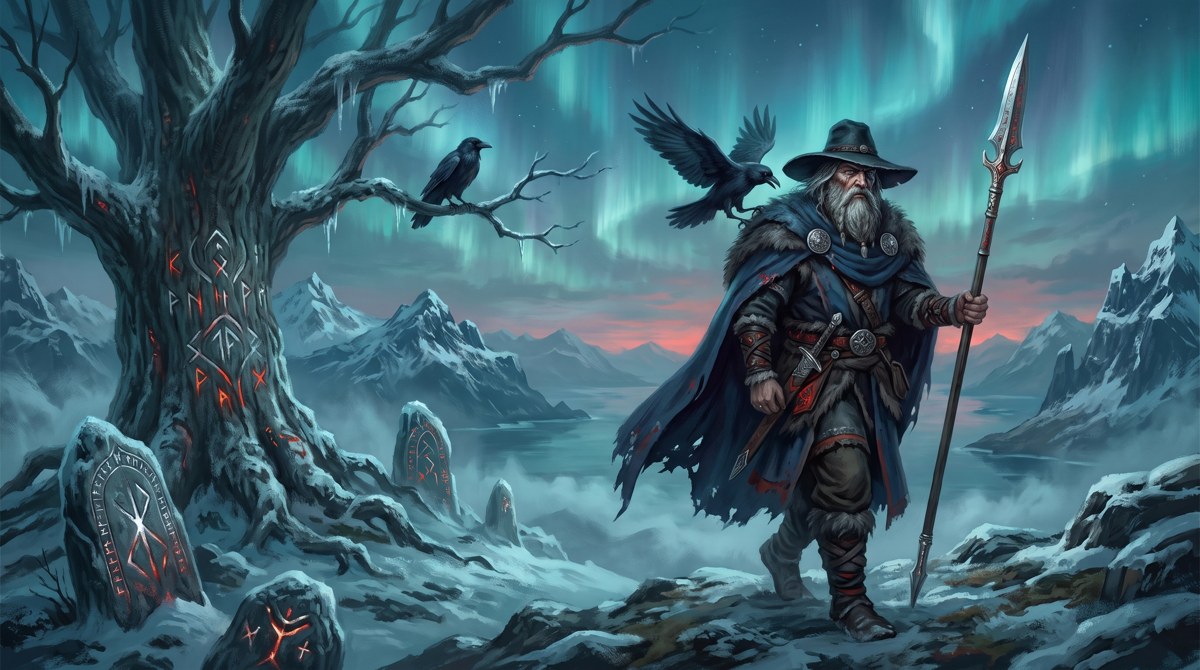
AI-generated editorial illustration, not a documentary image.
There is no established Norse myth in which Odin starts as the god of one thing and is later promoted to All-Father. All-Father is a title used alongside his associations with wisdom, war, poetry, magic and the dead. He does not stop having those roles when he leads the gods. If the question concerns Marvel’s Asgard, that fictional biography must be separated from Norse religious history: it also does not establish an earlier, exclusive divine job that the title replaced.
The tempting answer “he was the god of war first” turns a complicated historical question into a tidy superhero origin story. Scholars can study the changing evidence for worship of Odin and related Germanic names, but that is different from finding a canonical promotion scene. This Trivia Quiz World guide separates the title, the portfolios and the surviving evidence, so the answer stays useful whether you arrived through mythology or Marvel.
All-Father is a title, not a retired job description
Britannica describes Odin as chief of the Æsir and associates him with war, wisdom and poetry at the same time. Divine titles and domains overlap. Calling him All-Father expresses a kind of seniority and creative authority; it does not mean every god has him as a biological father, or that he becomes the only deity connected with warfare. Thor, for instance, does not cease to exist when Odin receives a grand title.
| Association | How to read it |
|---|---|
| Wisdom | Knowledge sought through sacrifice and experience, not effortless omniscience |
| War | Victory and fallen warriors; not the only Norse deity linked to conflict |
| Poetry | Inspiration and the mythic acquisition of the mead of poetry |
| Magic and runes | Myths about gaining knowledge; not proof every historical inscription was magical |
| The dead | A connection with fallen warriors, not sole ownership of every afterlife |
| All-Father | A title used alongside these associations, not their replacement |
Odin, Woden and Wodan: older names, incomplete evidence
Odin belongs to a wider Germanic religious history. Woden and Wodan are related forms of the name, and English Wednesday preserves Woden’s name. That linguistic survival is a striking bit of everyday trivia, but it is not a complete biography of the god. A name in a weekday cannot tell us the exact order in which all his divine associations arose.
The Roman author Tacitus wrote that Germanic peoples especially worshipped a deity he called Mercury. Scholars commonly connect that description with Wodan. The qualification matters: Tacitus used a Roman identification, not the explicit name Odin. His account is indirect evidence interpreted across cultures, rather than a labeled snapshot proving Odin’s original and exclusive function.
What the Vindelev inscription actually tells us
In 2023 the National Museum of Denmark announced an early-fifth-century gold bracteate from the Vindelev hoard as the earliest known inscription explicitly naming Odin. The important phrase is interpreted as “He is Odin’s man.” A bracteate is a thin, decorated gold object; the scholarly study identifies this one as IK 738. The wording connects a figure with Odin, without requiring the portrait itself to depict the god.
That is evidence that the name and a relationship to the deity were meaningful at that time. It is not Odin’s birth certificate, the first day anyone worshipped him, or proof that every later story already existed in its familiar form. Archaeological discoveries can move the earliest known evidence backward; “earliest known” should never be silently changed into “the beginning.”
The runes story shows overlapping roles, not a promotion
In Hávamál, Odin describes hanging in a tree for nine nights, wounded by a spear, as part of gaining runic knowledge. This is a mythic account of costly knowledge. Wisdom, ritual sacrifice and magic meet in the same episode. The National Museum’s discussion of rune magic also warns against assuming that every everyday historical use of runes was a spell. Stories about divine knowledge and evidence about how people wrote are related but different subjects.
If you mean Marvel’s Odin, use Marvel’s biography
Marvel’s comics biography identifies Odin as Bor’s son and describes his early rule with brothers Vili and Ve. After their apparent deaths, he receives their divine energies and assumes sole rule of Asgard. That provides a fictional succession narrative, not an account of how Norse belief historically developed. It also does not justify labeling him an exclusive “god of war” before kingship. Comics, the MCU and medieval texts should not be merged into a single timeline.
The short answer worth remembering
Odin was associated with several things, not one former job. All-Father is a title that coexists with those roles. If someone asks what he was god of “before,” ask whether they mean historical religion, a particular myth or a Marvel adaptation. That one distinction prevents a false premise from turning into a confident but misleading answer.
Odin: titles, myths and early evidence
Question 1 of 10
Does All-Father replace Odin’s other divine associations?
Sources & further reading
Sources checked for this article’s publication on October 29, 2026. Study figures retain their original publication dates.
- Britannica — Odin’s overlapping roles and title
- Britannica — Germanic Odin/Wodan and Roman identification
- National Museum of Denmark — Vindelev Odin inscription announcement
- Imer and Vang Petersen — scholarly Vindelev inscription study
- National Museum of Denmark — runic magic and Hávamál
- Marvel — Odin comics biography
- Britannica — Odin and Woden’s day
Shop this topic on Amazon
As an Amazon Associate we earn from qualifying purchases.
Test yourself on this topic
Comments
Share your score, argue with a question or add a fact we missed. Comments are checked before they appear, and links are removed automatically.
- No comments yet. Be the first.