

A Scary Universe Fact: Light We May Never Receive
Space · 6 min read · 10/29/2026
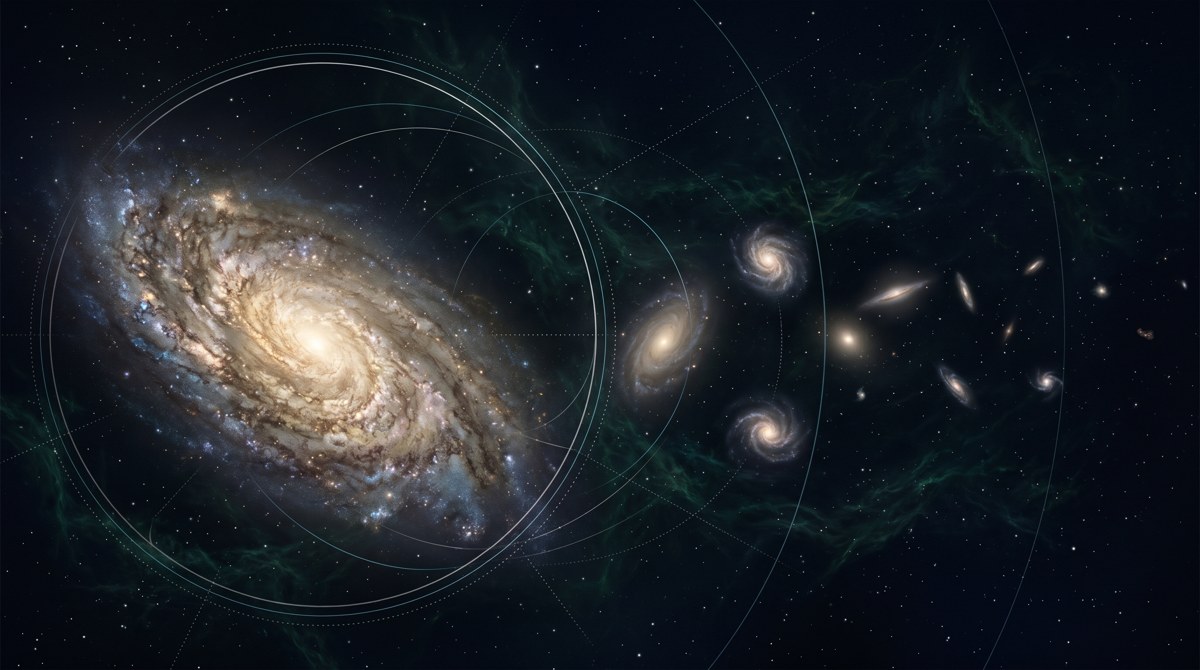
AI-generated editorial illustration, not a documentary image.
A scary fact about our universe is that, under the standard cosmological model, some galaxies we can see through ancient light are already so distant that light they emit today will never reach us. Seeing their past does not guarantee receiving their present. If dark energy behaves like a cosmological constant, the distant universe becomes increasingly inaccessible. That is a conditional cosmological prediction—not a claim that every galaxy suddenly disappears or that a disaster is imminent.
The unsettling part is an information limit. A perfect telescope cannot recover a signal that will never arrive. Nor does that require a black hole or something physically attacking a galaxy. Expansion can separate distant regions in a way that makes future communication impossible. This article focuses on that one idea rather than repeating our broad space-facts list or treating speculative doomsday scenarios as established forecasts.
Ancient light is not live news
Light takes time to travel. When astronomers observe a distant galaxy, they receive light emitted in its past. Meanwhile the universe’s expansion history affects the route available to later signals. In models with a cosmic event horizon, a galaxy may remain visible through earlier emissions even though a signal emitted there at the relevant later time can never catch up with us. Past visibility and future communication are different questions.
“Today” is shorthand for the model’s cosmological time coordinate, not a claim that we have a universally accessible live clock in that galaxy. The main point survives that technical nuance: our observations carry old information. A distant object need not abruptly vanish when its newly emitted light becomes inaccessible. Earlier light can continue arriving, with the image increasingly redshifted and faint.
Three cosmic boundaries that are not the same
| Boundary | Question it answers | What not to assume |
|---|---|---|
| Particle horizon | How far could light have traveled to us over cosmic history? | It is not the limit on every future signal |
| Hubble sphere | Where does the modeled recession speed equal light speed at that time? | It is not automatically an event horizon |
| Cosmological event horizon | Can signals emitted at a specified time ever reach us? | Its existence and location depend on expansion history |
| Black-hole event horizon | Can a signal escape a black hole’s interior? | It is a different physical setting from cosmic expansion |
The peer-reviewed “Expanding Confusion” paper explains why the Hubble sphere is often mistaken for a visibility boundary. We can observe galaxies whose cosmological recession speeds exceed light speed. That does not violate special relativity’s local speed limit: expansion-based recession is not simply a spacecraft locally overtaking a beam of light. Nor does a faster-than-light recession value, by itself, prove that all future emissions are permanently unreachable.
What dark energy explains—and what remains unknown
Observations, famously including Type Ia supernova distance measurements, show that cosmic expansion is accelerating. Dark energy names the unexplained ingredient associated with this behavior; it is not a fully understood substance in a bottle. In the standard ΛCDM picture, a cosmological constant supplies a persistent component that leads to a particular future expansion history. Predictions about permanent horizons inherit that assumption.
The uncertainty is real. DESI’s March 2025 results strengthened hints, when combined with other observations, that dark energy may evolve. The cited announcement also says DESI alone remained consistent with the standard model. Hints are not a definitive discovery, and that dated result is not presented here as an exhaustive statement of all later research. It is a concrete reminder that “we measured acceleration” and “we know exactly how expansion behaves forever” are different claims.
Why our neighboring galaxies do not simply fly apart
Gravity holds bound systems together. The Milky Way and Andromeda are members of the Local Group; galaxy groups and clusters can be gravitationally bound. It is therefore wrong to say expansion makes every galaxy retreat from every other galaxy or steadily stretches everything inside your house. The large-scale expansion description is not a universal instruction for local structures to disassemble.
Far-future simulations assuming a cosmological constant illustrate increasing isolation of local bound structures from the wider cosmos. They are useful for understanding the idea, not for promising a specific merger date or the exact year a particular galaxy becomes unobservable. We can explain the bound-neighbor exception without claiming the Local Group has a guaranteed, fully known future configuration.
An information limit, not an imminent apocalypse
A cosmic horizon does not mean a galaxy is destroyed. It means particular information cannot reach a particular observer under the relevant expansion history. It also does not imply a confirmed Big Rip, in which a very different dark-energy scenario would disrupt bound structures. Those ideas are often bundled together because they sound frightening, but they make different assumptions and should be evaluated separately.
- Old light can remain observable even when new signals cannot arrive.
- The Hubble sphere and the event horizon are not synonyms.
- Gravitationally bound neighbors are an essential exception to blanket isolation claims.
- Permanent far-future predictions depend on how dark energy behaves.
The genuine scary fact is subtler than an explosion: the universe may contain places whose later history is permanently beyond our access. Better instruments expand what we can measure, but they cannot repeal an information horizon. At the same time, the scientific answer includes its limits. We know expansion is accelerating; its deepest explanation and ultimate future remain active subjects of research.
Cosmic horizons: ten careful distinctions
Question 1 of 10
What name is used for the unexplained ingredient associated with accelerating expansion?
Sources & further reading
Sources checked for this article’s publication on October 29, 2026. Study figures retain their original publication dates.
- Davis and Lineweaver — Expanding Confusion, peer-reviewed horizon distinctions
- NASA — dark energy
- NASA — large-scale structures and the Local Group
- Nagamine and Loeb — future-structure model assuming a cosmological constant
- Berkeley Lab — dated March 2025 DESI results and caveats
- NASA Hubble — discovering accelerating expansion
Shop this topic on Amazon
As an Amazon Associate we earn from qualifying purchases.
Test yourself on this topic
Space · 15 questions
Universe Quiz: Test Your Knowledge of the Cosmos
A 15-question universe quiz on the Big Bang, dark matter, dark energy, cosmic expansion and the scale of the cosmos.
Space · 15 questions
Stars and Galaxies Quiz: How Much Do You Know?
A 15-question stars and galaxies quiz on star life cycles, red giants, supernovae, the Milky Way, Andromeda and galaxy types.
Space · 15 questions
Astronomy Quiz: Are You a True Space Expert?
A hard 15-question astronomy quiz on magnitudes, parallax, spectral classes, Kepler's laws and famous astronomers. Are you a true space expert?
Comments
Share your score, argue with a question or add a fact we missed. Comments are checked before they appear, and links are removed automatically.
- No comments yet. Be the first.