
Amazing Animal Facts That Will Change Your View
Animals · 9 min read · 9/15/2026
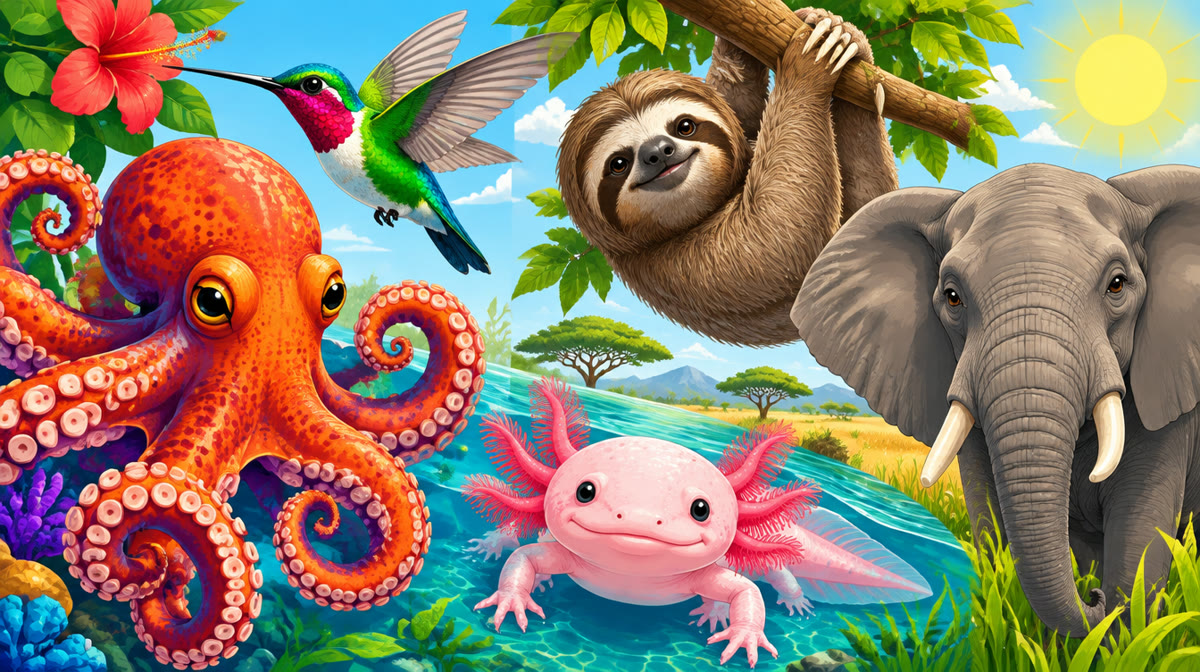
Animals face the same basic problems as humans, from finding food to avoiding predators, yet evolution has produced wildly different solutions across the tree of life. Some of the strangest answers hide inside familiar creatures, while others belong to species most people never encounter. Looking closely at how bodies actually work reveals a far weirder planet than casual observation suggests.
Vision built for a different world
Mantis shrimp possess up to sixteen types of photoreceptors, compared with three in humans, and their compound eyes can move independently. Researchers still debate exactly how the shrimp's brain uses that information, since the animals perform poorly on colour-discrimination tasks that would seem simple given their equipment. The lesson is that more receptors do not automatically mean sharper perception.
- Mantis shrimp can also punch with acceleration strong enough to create cavitation bubbles.
- Pigeons can detect magnetic fields, aiding navigation over long distances.
- Some snakes sense infrared heat through pit organs near their nostrils.
- Bees see ultraviolet patterns on flowers invisible to the human eye.
Regeneration beyond human limits
Zebrafish can regrow damaged heart tissue, a feat that has made them a major research subject for regenerative medicine. Axolotls go further still, regrowing entire limbs, portions of their spinal cord and even parts of their brain without forming scar tissue. Scientists study these species hoping to understand why mammals lost such abilities during evolution.
An axolotl's greatest trick is not surviving an injury, but rebuilding exactly what was lost instead of simply patching the wound.
Extreme survival specialists
Tardigrades, tiny eight-legged invertebrates often called water bears, can survive extreme desiccation by entering a dormant state called cryptobiosis. In this condition they have withstood exposure to the vacuum of space during controlled experiments, though the popular idea that they thrive there is an overstatement. Their real achievement is surviving conditions that would kill nearly any other animal outright.
Communication most people miss
Elephants produce low-frequency rumbles that travel through the ground and air over long distances, allowing separated herd members to coordinate. Some of these calls fall below the threshold of human hearing entirely. Researchers use seismic sensors and specialised microphones to study communication that elephants have apparently used for a very long time.
- Octopuses can change both colour and skin texture within a fraction of a second.
- Naked mole rats show little cancer incidence and can survive long periods with very low oxygen.
- Crows have passed tests involving tool use and multi-step problem solving.
- Some fish, like certain wrasses, change sex during their lifetime depending on social conditions.
Why these facts matter
Understanding unusual animal biology is not just entertainment. Axolotl regeneration informs medical research, tardigrade resilience interests scientists studying extreme environments, and elephant communication shapes conservation strategy. Each strange fact connects to a larger question about how life adapts under pressure.
The animal kingdom keeps surprising researchers precisely because evolution does not aim for one ideal design. It experiments constantly, and the results, however odd, usually work well enough for the animal in question to survive and reproduce.
Shop this topic on Amazon
As an Amazon Associate we earn from qualifying purchases.
Test yourself on this topic
Animals · 12 questions
Animal Oddities Quiz: 12 Facts That Sound Made Up
Twelve questions about record breakers, strange defences and animals whose reputations are entirely wrong.
Animals · 12 questions
Ocean Giants Quiz: The Biggest Animals in the Sea
Blue whales, whale sharks, giant squid and more. Twelve questions on the ocean's largest residents.
Comments
Share your score, argue with a question or add a fact we missed. Comments are checked before they appear, and links are removed automatically.
- No comments yet. Be the first.