

Why Lions Eat Raw Meat—and Why We Cook Ours
Animals · 5 min read · 10/10/2026
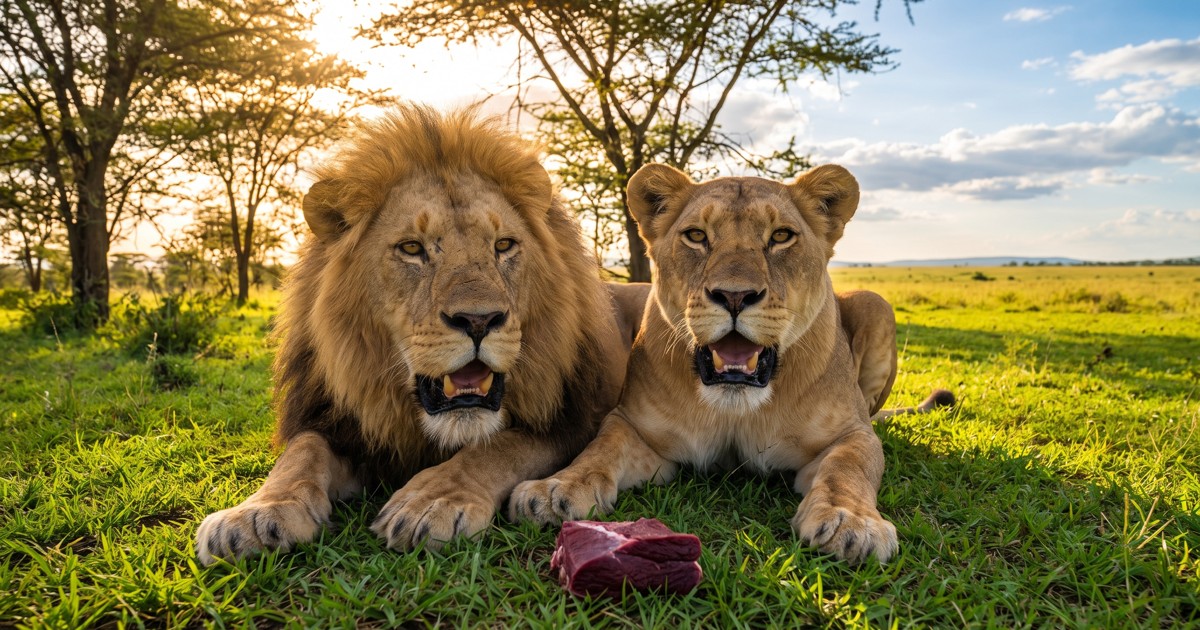
AI-generated cover illustration. Sources and study notes below.
Lions eat raw meat because they are carnivores adapted to a meat-based diet, but the usual comparison starts with a mistake: humans can physically eat raw meat too. The problem is that raw meat can carry bacteria and parasites that cause illness. Lions are not immune to those hazards. Cooking is one of the ways humans make meat safer; it is not evidence that our stomachs cannot digest uncooked animal protein.
A lion’s body is built for carnivory
Lions use large canine teeth to grip prey and specialized cutting teeth to slice flesh. Their diet in the wild consists largely of other animals, and they also scavenge when an opportunity arises. That feeding ecology differs from a human omnivorous diet. It explains why a lion does not need a kitchen to obtain nourishment, not why every uncooked meal is harmless. An adaptation to a diet is not a protective force field against every microbe in it.
Do lions have stronger stomach acid than humans?
Stomach acidity can help filter microbes arriving with food. A 2015 comparative review by Beasley and colleagues found patterns relating acidity to feeding ecology across the species for which data were available. Scavengers tended to have very acidic stomachs, but the review also reported highly acidic human stomachs. It does not support the simplistic internet claim that humans have weak stomach acid while lions have acid that kills everything.
Measurements depend on conditions such as fasting and recent feeding. Broad comparisons among carnivores and herbivores are not a measured lion-versus-human experiment. We therefore do not assign a convenient pH number to lions or claim their acid is a fixed number of times stronger. Acid is one defense among several, and some pathogens survive the journey through a stomach.
Digesting meat and avoiding infection are different jobs
Digestive enzymes break proteins into components the body can absorb. Infection risk depends on whether disease-causing organisms are present and survive to cause harm. A person can digest a raw steak and still develop food poisoning. A lion can obtain useful nutrients from prey while also being exposed to parasites or bacteria. Neither the ability to chew flesh nor the presence of stomach acid proves a meal is safe.
Why raw ground meat deserves special care
Contamination can occur during slaughter, processing, storage or preparation. Grinding can distribute organisms from the surface through the meat, so a cooked-looking exterior does not establish a safe interior. The CDC documented an E. coli O157:H7 outbreak associated with eating raw ground beef in Wisconsin in 2013. That is direct evidence of illness in humans, not merely a theoretical concern or a claim about what our ancestors might have eaten.
| Food | Temperature | Additional requirement |
|---|---|---|
| Whole beef, pork, veal and lamb steaks, chops and roasts | 145°F / 63°C | Rest for at least 3 minutes |
| Ground meats | 160°F / 71°C | Check with a food thermometer |
| Poultry, including ground poultry | 165°F / 74°C | Check with a food thermometer |
These are U.S. USDA recommendations for the named foods; other products and local guidance may have different requirements. Measure the appropriate part of the food with a thermometer. Color, smell and texture do not reliably reveal pathogens. Freezing is not a universal substitute for cooking and does not reliably eliminate every bacterial hazard.
Four food-safety myths to leave behind
- ‘Fresh means sterile.’ Fresh meat can still be contaminated.
- ‘Lions never get sick.’ Wild animals can become infected; surviving a meal is not proof of zero exposure.
- ‘Stomach acid kills everything.’ Acidity is a defense, not guaranteed sterilization.
- ‘The outside looks cooked, so the middle is safe.’ This is especially misleading for ground meat; use a thermometer.
The takeaway is safer food, not a raw-meat challenge
Raw-meat dishes exist, but their existence does not remove the risk. People at higher risk of severe foodborne illness should be especially careful and follow professional food-safety guidance. Keep raw meat separate from ready-to-eat food, wash hands and utensils after handling it, and maintain appropriate refrigeration. Comparing ourselves with lions is useful for learning about ecology; it is not a reason to imitate their meals or feed pets an unassessed raw diet. This is general educational information, not veterinary or individualized medical advice.
Lions, digestion and food safety
Question 1 of 10
Can humans physically digest raw meat?
Sources & further reading
Sources checked for this article’s publication on October 10, 2026. Study figures retain their original publication dates.
Shop this topic on Amazon
As an Amazon Associate we earn from qualifying purchases.
Test yourself on this topic

Comments
Share your score, argue with a question or add a fact we missed. Comments are checked before they appear, and links are removed automatically.
- No comments yet. Be the first.