

Cartoons Around the World: Animation History Trivia
Cartoons · 5 min read · 11/17/2026
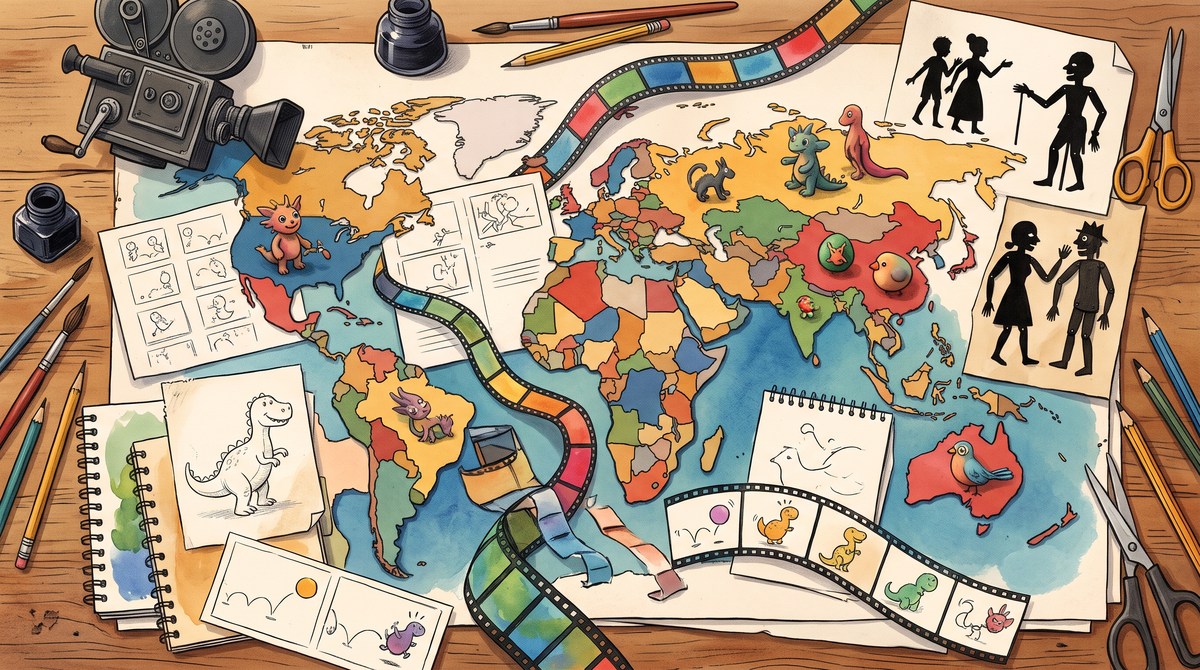
Original editorial illustration inspired by hand-drawn, cut-out and stop-motion animation.
Cartoons are often treated as one style, but animation is a toolbox used differently around the world. Artists have moved drawings, cut paper, silhouettes, puppets, clay and even marks made directly on film. This cartoon trivia article starts with a few documented milestones rather than declaring one studio or country the inventor of everything.
Newspaper artists helped drawings move
MoMA traces early film animation partly through newspaper and magazine cartoonists in Europe and the United States. France’s Émile Cohl and America’s Winsor McCay both brought that graphic experience to film. McCay’s Gertie the Dinosaur (1914) gave audiences a drawn character with a memorable personality, while The Sinking of the Lusitania (1918) used animation for a serious historical subject. Cartoons were never restricted to jokes for children.
Argentina’s El Apóstol arrived in 1917
Quirino Cristiani’s El Apóstol premiered in Argentina in 1917. Argentina’s official cultural history describes it as a 60-minute silent political satire made from 58,000 frames over the course of a year. Its story sends President Hipólito Yrigoyen to seek Jupiter’s thunderbolts as a way to clean up Buenos Aires. Because the film is lost, later claims need care; the surviving production record still makes it a crucial milestone in animated-feature history.
Paper silhouettes became a feature-length adventure
Lotte Reiniger’s The Adventures of Prince Achmed (1926) is the oldest surviving full-length animated film, according to The Metropolitan Museum of Art. Reiniger articulated cut-out figures and photographed their movements frame by frame. Korea’s National Museum of Modern and Contemporary Art notes that the production took three years and involved roughly 250,000 photographs. The result looks delicate, but the labor behind it was immense.
Cut-outs took different paths in Japan and beyond
The Museum of Animation’s international survey lists Noburo Ofuji’s The Burglars of Baghdad Castle (1926) as an example of Japanese chiyogami animation, using patterned paper. Elsewhere, Karel Zeman combined live action with animation and puppetry, while Yuri Norstein created atmospheric cut-out films such as Hedgehog in the Fog (1975). These works do not resemble one another simply because paper was involved; each artist used the medium for a different visual rhythm.
Canada encouraged experimentation without a camera
Norman McLaren joined the National Film Board of Canada in 1941 and directed more than 70 films. He painted and scratched directly onto film, experimented with cut-outs and used live performers in the Oscar-winning Neighbours. MoMA’s account of postwar animation also highlights Britain’s John Halas and Joy Batchelor, who made the feature-length Animal Farm (1954), and Czech filmmaker Jiří Trnka, whose puppet films followed another branch of the craft.
| Year | Artist or film | Why it matters |
|---|---|---|
| 1914 | Winsor McCay — Gertie the Dinosaur | A landmark in personality-driven drawn animation. |
| 1917 | Quirino Cristiani — El Apóstol | An early feature-length political satire from Argentina. |
| 1926 | Lotte Reiniger — The Adventures of Prince Achmed | The oldest surviving full-length animated film. |
| 1926 | Noburo Ofuji — The Burglars of Baghdad Castle | An example of Japanese chiyogami cut-out animation. |
| 1954 | Halas and Batchelor — Animal Farm | A British feature-length adaptation made in animation. |
| 1955 | Norman McLaren — Blinkity Blank | One product of McLaren’s wide-ranging Canadian experiments. |
A better way to answer ‘Who invented cartoons?’
There is no tidy single answer. Animation developed through many techniques and independent experiments, some now lost and others preserved in museum collections. A stronger trivia question names the technique, country and survival status: Who directed Gertie? What was distinctive about Prince Achmed? Why does El Apóstol matter even though it is lost? Those questions reward real knowledge instead of a simplistic first-place claim.
For character-focused rounds, visit our Cartoon Classics, 90s Cartoons and Cartoon Theme Songs quizzes.
Animation around the world: 10 questions
Question 1 of 10
Who created Gertie the Dinosaur?
Sources & further reading
Sources checked for this article’s publication on November 17, 2026. Study figures retain their original publication dates.
- MoMA — Early Animation
- Government of Argentina — Quirino Cristiani and El Apóstol
- The Met — Lotte Reiniger and The Adventures of Prince Achmed
- MoMA — Animation Abroad, 1946–59
- Museum of Animation — Stories of Cut-Out Animation
- Korea’s National Museum of Modern and Contemporary Art — Movement Making Movement
Shop this topic on Amazon
As an Amazon Associate we earn from qualifying purchases.
More like this: explore our Around the World Trivia hub on Trivia Quiz World.
Test yourself on this topic

Cartoons · 12 questions
Cartoon Classics Quiz: Do You Remember Saturday Mornings?
A friendly twelve-question trip through decades of animated television, from talking dogs to catchphrases you still use.

Cartoons · 12 questions
90s Cartoons Quiz: Saturday Morning Trivia
The decade of cable cartoons, weird premises and unforgettable theme tunes. Twelve questions.
Cartoons · 12 questions
Cartoon Theme Songs Quiz: Name That Opening
How well do you remember the songs and opening lines that introduced classic animated shows?
Comments
Share your score, argue with a question or add a fact we missed. Comments are checked before they appear, and links are removed automatically.
- No comments yet. Be the first.