
Volcano Facts That Sound Fake But Are True
Nature · 8 min read · 9/15/2026
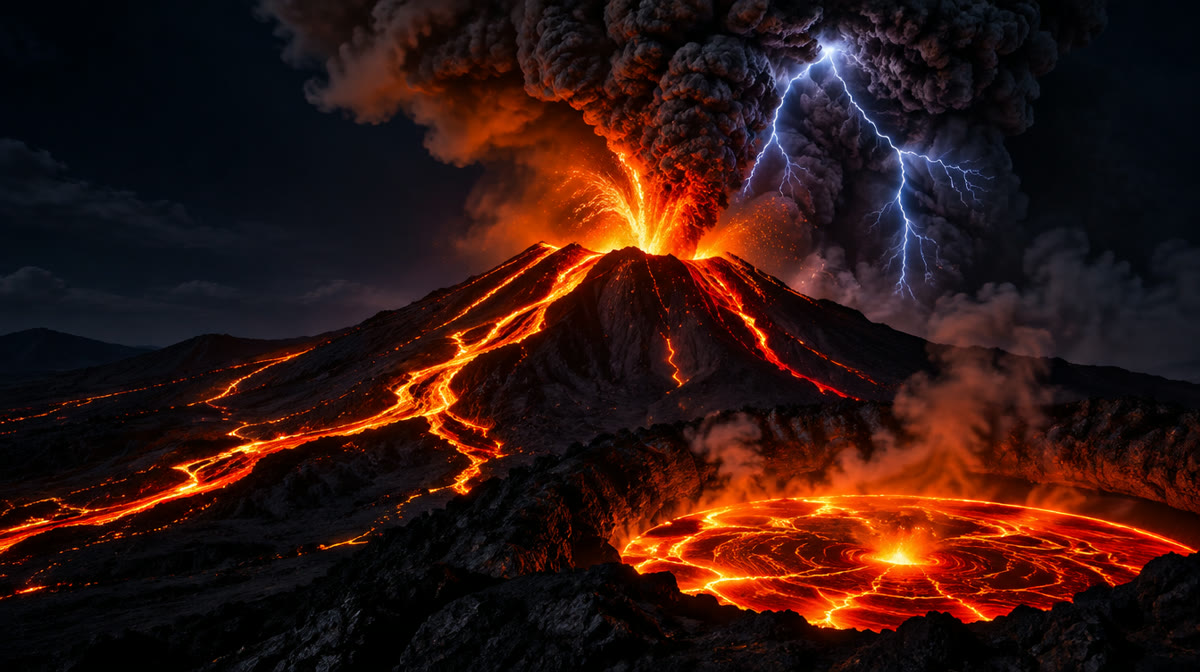
Volcanoes produce some of the most dramatic natural phenomena on Earth, and many of the strangest details are entirely factual despite sounding exaggerated. Understanding the science behind them reveals just how much energy and chemical complexity is packed into a single eruption.
Volcanic lightning is a real phenomenon
Some eruptions generate their own lightning storms, a phenomenon researchers call volcanic lightning, caused by the friction and collision of ash particles, ice and rock fragments building up static electrical charge within the eruption plume. This has been documented at eruptions including Mount Sakurajima in Japan and the 2010 Eyjafjallajökull eruption in Iceland.
Blue flames come from burning sulfuric gas
At Indonesia's Kawah Ijen volcano, glowing blue flames appear at night, caused by sulfuric gases igniting as they escape vents under high pressure and temperature, rather than the lava itself glowing blue. The phenomenon draws tourists and researchers alike, though the toxic gases involved make close observation genuinely hazardous.
What looks like blue lava is really burning gas, a detail that changes nothing about how striking it looks at night.
- Kawah Ijen also hosts one of the world's largest highly acidic crater lakes.
- Volcanic gases at Kawah Ijen are harvested commercially by local sulfur miners.
- Volcanic lightning has also been recorded at Mount Etna and Mount St. Helens.
- Ash particle friction is considered the leading explanation for volcanic lightning generation.
Eruptions can cool the entire planet
Large eruptions can inject sulfur dioxide into the stratosphere, forming aerosols that reflect sunlight and temporarily cool global temperatures. The 1991 eruption of Mount Pinatubo in the Philippines lowered average global temperatures by roughly half a degree Celsius for more than a year afterward.
The Year Without a Summer
The 1815 eruption of Mount Tambora in Indonesia remains the most powerful eruption recorded in modern history, ejecting enormous volumes of ash and gas into the atmosphere. The resulting climate disruption caused widespread crop failures in 1816, an event historians now call the Year Without a Summer, affecting food supplies across parts of Europe and North America.
- Mount Tambora's eruption is estimated to have killed tens of thousands of people directly and indirectly.
- Volcanic winter effects from Tambora contributed to unusual weather patterns worldwide.
- Some historians link the 1816 crop failures to increased migration and economic hardship in affected regions.
- Modern volcanologists monitor sulfur dioxide emissions as one indicator of eruption potential.
Volcanoes shape land as well as destroy it
Beyond destruction, volcanic activity created much of Earth's fertile soil and even formed entire islands, including the Hawaiian archipelago, built by a hotspot of persistent volcanic activity beneath the Pacific tectonic plate. Volcanic soil's mineral richness supports some of the most productive agricultural regions in the world.
Volcanoes therefore act as both destroyer and creator, reminding us that some of Earth's most fertile landscapes and strangest natural spectacles share the very same violent origin.
Shop this topic on Amazon
As an Amazon Associate we earn from qualifying purchases.
Test yourself on this topic
Nature · 12 questions
National Parks Quiz: Landscapes, Wildlife and Firsts
Geysers, canyons, rainforests and the world's oldest protected parks. Twelve questions.
Nature · 12 questions
Extreme Weather Quiz: Storms, Records and Wild Skies
Hurricanes, tornado scales, hailstones and temperature records. Twelve questions about weather at its most dramatic.

Global Knowledge · 12 questions
World Capitals Quiz: 12 Countries, 12 Capital Cities
The capitals people get wrong most often, spread across five continents. Twelve questions, no repeats.
Comments
Share your score, argue with a question or add a fact we missed. Comments are checked before they appear, and links are removed automatically.
- No comments yet. Be the first.