
Surprising Facts About Money and Its History
Global Knowledge · 8 min read · 9/15/2026
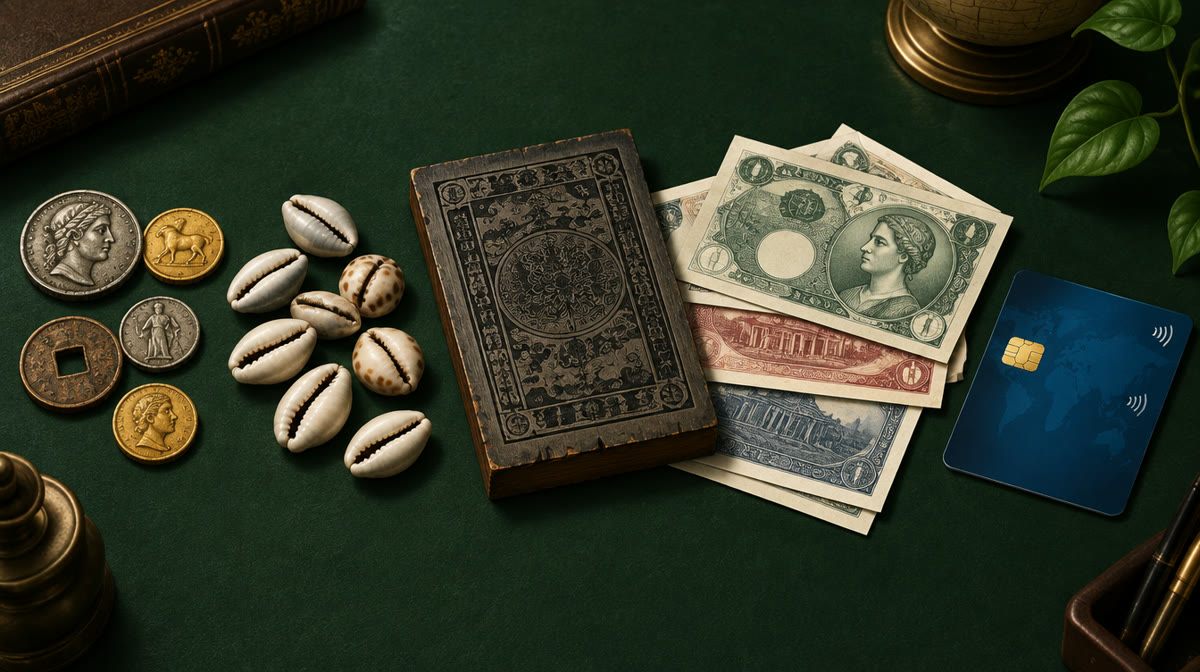
Money feels like a fixed, obvious concept, yet its form and meaning have changed dramatically across history. Societies have used shells, stones, metal coins, paper notes and now digital records to represent value, and each shift reveals something about trust, technology and trade.
Before coins, there were commodities
Many early economies used commodity money, items with intrinsic value or usefulness, such as cattle, grain or cowrie shells, to facilitate trade before standardized coinage existed. Cowrie shells in particular circulated as currency across parts of Africa and Asia for centuries due to their durability and difficulty to counterfeit.
The first coins appeared in ancient Lydia
Historians generally credit the kingdom of Lydia, in present-day Turkey, with producing some of the earliest standardized metal coins around the 7th century BCE, made from electrum, a naturally occurring gold and silver alloy. Standardized coinage simplified trade by removing the need to verify weight and purity for every transaction.
A coin works because strangers agree to trust its stamped value without checking every time.
- The world's largest stone money, called Rai stones, was used on the island of Yap in Micronesia.
- Paper currency first developed in China during the Tang and Song dynasties.
- The gold standard tied currency value to a fixed amount of gold for much of modern history.
- Many countries abandoned the gold standard during the 20th century in favour of fiat currency.
Polymer banknotes improve durability
Australia introduced polymer banknotes in 1988, developed partly to resist counterfeiting and last significantly longer than traditional paper notes. Numerous countries have since adopted polymer or polymer-hybrid banknotes, citing improved durability and enhanced security features like transparent windows.
Inflation can make currency nearly worthless
Extreme hyperinflation events, such as those in Weimar Germany in the 1920s or Zimbabwe in the late 2000s, caused currency values to collapse so severely that banknotes were issued in denominations of trillions. These episodes illustrate how money's value depends entirely on public confidence rather than the paper or metal itself.
- Zimbabwe issued a 100 trillion dollar banknote during its hyperinflation crisis.
- Central banks manage monetary policy partly to try to keep inflation within a target range.
- Digital payment systems have reduced physical cash use in many countries.
- Some economists study cryptocurrencies as an alternative model of decentralized value exchange.
Trust is the real currency
Whatever physical or digital form money takes, its function depends on widespread agreement that it can reliably be exchanged for goods and services later. That shared trust, more than any metal or printed paper, is the actual foundation of every monetary system in history.
Understanding money's strange history helps explain why modern debates over digital currency and central bank policy are, in many ways, a continuation of questions societies have faced for thousands of years.
Shop this topic on Amazon
As an Amazon Associate we earn from qualifying purchases.
Test yourself on this topic
Global Knowledge · 12 questions
World Capitals Quiz: 12 Countries, 12 Capital Cities
The capitals people get wrong most often, spread across five continents. Twelve questions, no repeats.

Fun Math Tests · 12 questions
Fun Math Test: 12 Quick Puzzles, No Calculator
Mental arithmetic, number patterns and classic puzzles, each with the shortcut explained afterwards.
Comments
Share your score, argue with a question or add a fact we missed. Comments are checked before they appear, and links are removed automatically.
- No comments yet. Be the first.