
Did You Know? 15 Ocean Facts That Rewrite the Map
Nature · 8 min read · 2/5/2026
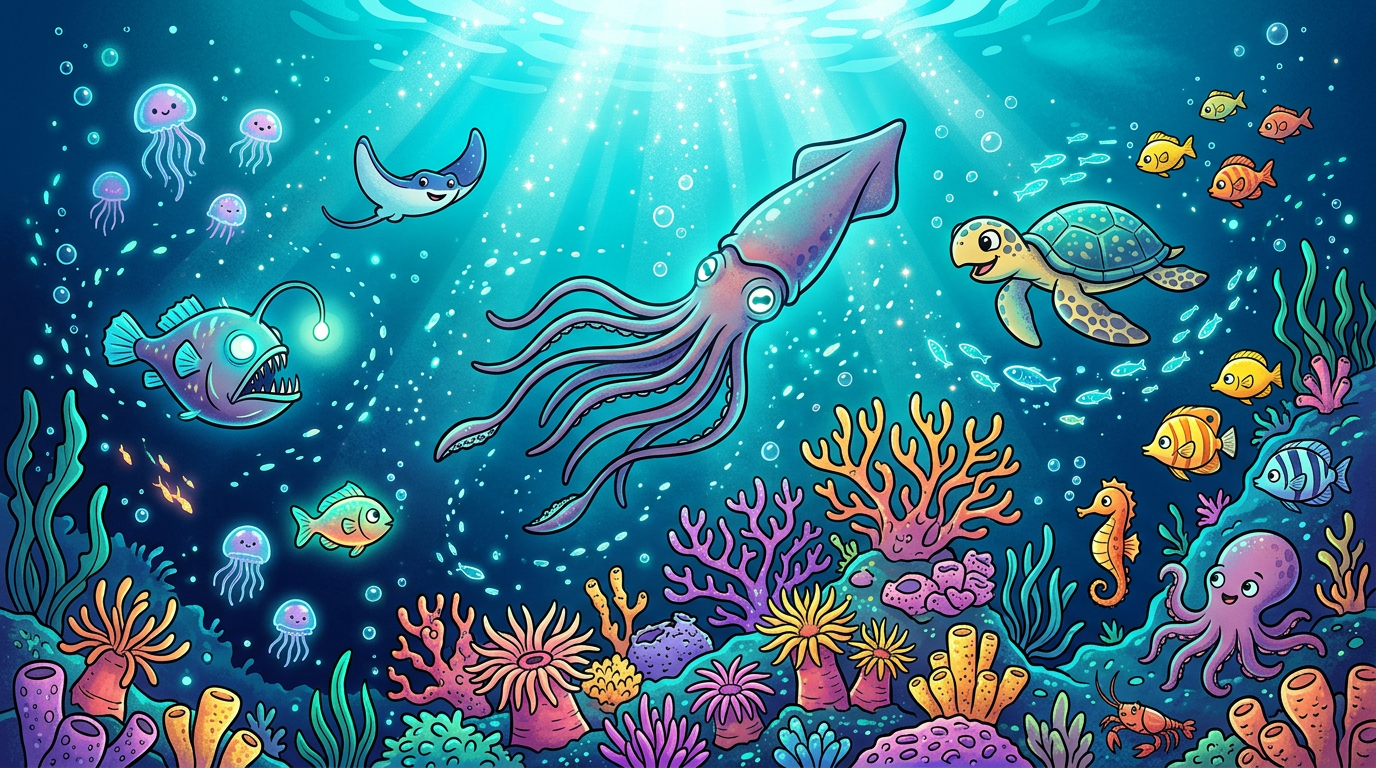
We describe Earth as a blue planet without really absorbing what that means. Saltwater covers roughly 71 percent of the surface and holds about 97 percent of all the water on the planet. Everything humans have built, farmed and fought over sits on the remaining sliver, and most of us will never see more than the top few metres of the rest.
That imbalance is why ocean trivia feels so unreal. The facts below are not exaggerations for effect. They are the ordinary conditions of the largest habitat on Earth, one that happens to be almost entirely hostile to us.
The map is mostly guesswork
Modern satellite gravimetry gives us a rough shape of the entire seafloor, but high-resolution sonar mapping, the kind that shows individual ridges and wrecks, still covers only a minority of it. That is why new seamounts, hydrothermal vents and even sizeable underwater volcanoes are still being announced every year. We have a better detailed map of the surface of Mars than of our own seabed.
The deepest known point is Challenger Deep in the Mariana Trench, at nearly 11 kilometres. Drop Mount Everest into it and roughly two kilometres of water would still sit above the summit. Only a handful of crewed descents have ever reached the bottom, and each one required a vessel engineered against pressure that would crush a submarine designed for normal military depths.
Life without sunlight
Sunlight effectively runs out at about 200 metres. Below that lies the twilight zone, then the midnight zone, and yet life continues all the way down. Instead of photosynthesis, entire ecosystems around hydrothermal vents run on chemosynthesis, converting chemicals from the Earth's interior into energy. When these communities were confirmed in 1977 they overturned the assumption that all food chains begin with the sun.
- Bioluminescence is not rare in the deep sea; it is the norm, used for hunting, mating and camouflage.
- Many deep-sea species grow slowly and live extraordinarily long lives; some corals are thousands of years old.
- The giant squid was photographed alive in its habitat only in the 2000s, despite being known from carcasses for centuries.
- Whale falls, the carcasses of large whales, can feed a unique local ecosystem for decades.
The ocean runs the weather
Ocean currents move heat around the planet on a scale no weather system can match. The Atlantic circulation carries warm water north and keeps parts of northwest Europe far milder than their latitude suggests. Meanwhile the Pacific's El Nino and La Nina cycles nudge rainfall and drought patterns on several continents at once.
Ocean plankton also produce a substantial share of the oxygen we breathe, with estimates commonly ranging from half to more than two thirds when averaged across long periods. Forests get the credit in most classroom posters, but a large part of every breath begins with microscopic organisms drifting near the surface.
The sea, once it casts its spell, holds one in its net of wonder forever.
Strange records worth remembering
- The blue whale is the largest animal known to have existed, larger than any dinosaur yet described.
- The longest mountain range on Earth, the mid-ocean ridge, is almost entirely underwater and stretches roughly 65,000 km.
- There are more historical artefacts on the seafloor than in all the world's museums combined, according to marine archaeologists.
- Sound travels roughly four and a half times faster in water than in air, which is why whale calls carry across ocean basins.
Why this matters beyond trivia
Every one of these facts has a practical edge. Understanding currents improves storm forecasting. Understanding deep-sea life shapes decisions about seabed mining. Understanding how much carbon the ocean absorbs changes climate modelling. Ocean trivia is one of the few kinds where the fun facts and the consequential science are the same facts.
If you want to test what stuck, our animal quizzes include a healthy share of marine questions, and the explanations go deeper than the answer itself.
Test yourself on this topic

Comments
Share your score, argue with a question or add a fact we missed. Comments are checked before they appear, and links are removed automatically.
- No comments yet. Be the first.