
Strange Space Discoveries That Puzzle Scientists
Nature · 9 min read · 9/15/2026
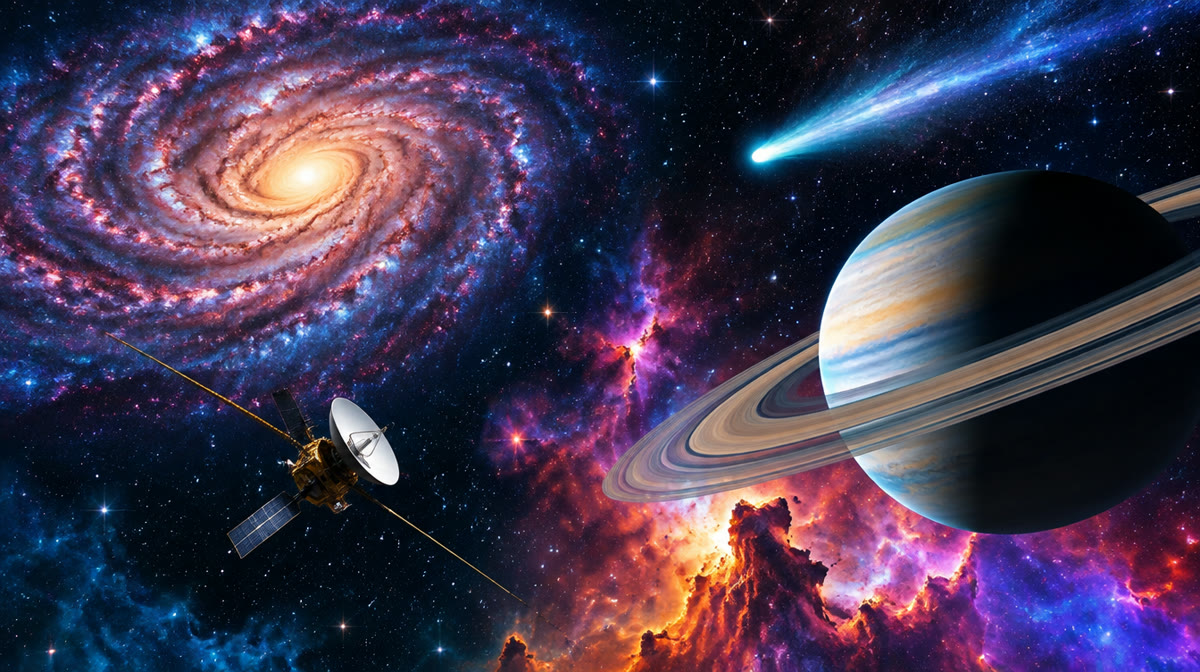
Astronomy regularly turns up objects and events that do not fit tidy expectations. Telescopes on the ground and in orbit continue to find phenomena that challenge existing models, forcing scientists to revise long-held assumptions about how stars, planets and galaxies behave.
Planets with no star to orbit
Rogue planets drift through space unattached to any star, likely ejected from their original systems by gravitational interactions during formation. Detecting them is difficult since they emit no starlight of their own, and astronomers rely on techniques like gravitational microlensing, where a rogue planet's gravity briefly bends and brightens light from a distant background star.
Radio bursts from unknown sources
Fast radio bursts are extremely brief, powerful pulses of radio energy arriving from distant galaxies. First identified in 2007, many remain unexplained, though magnetars, a type of highly magnetic neutron star, are considered strong candidates for at least some sources. Some bursts repeat on detectable patterns, while others have appeared only once.
A signal lasting a few milliseconds can carry energy comparable to what the sun releases over a much longer stretch of time.
- Fast radio bursts were first detected using the Parkes Observatory in Australia.
- Some fast radio bursts repeat on identifiable cycles, aiding source investigation.
- Magnetars have magnetic fields trillions of times stronger than Earth's.
- The exact mechanism producing these bursts is still debated among astrophysicists.
Weather unlike anything on Earth
Atmospheric models suggest that Neptune and Uranus may experience diamond rain, where extreme pressure and temperature compress carbon into solid diamond that sinks toward the planetary core. Laboratory experiments recreating similar pressures have supported this hypothesis, though no probe has directly observed the phenomenon inside either planet.
Galaxies that should not exist yet
Observations from the James Webb Space Telescope have identified galaxies that appear surprisingly massive and mature for how early they formed after the Big Bang. These findings have prompted astronomers to reconsider models of how quickly galaxies can grow, since the observed masses challenge some previous timelines for early star formation.
- The James Webb Space Telescope launched in December 2021.
- Some early galaxies observed appear more structured than earlier models predicted.
- Gravitational lensing helps astronomers see extremely distant, faint galaxies.
- Ongoing surveys continue to refine estimates of early cosmic star formation rates.
Why the unknown keeps growing
Each new instrument tends to reveal phenomena the previous generation of telescopes could not detect. Rather than closing questions, better technology often opens new ones, since finer resolution and wider wavelength coverage expose complexity that simpler observations smoothed over.
Space discoveries remind us that confident models are always provisional. The universe has repeatedly shown that stranger explanations sometimes fit the evidence better than familiar ones, and scientists must be willing to follow the data even when it defies expectation.
Shop this topic on Amazon
As an Amazon Associate we earn from qualifying purchases.
Test yourself on this topic
Global Knowledge · 12 questions
Space Missions Quiz: From Sputnik to Artemis
Test your knowledge of the missions, astronauts and robotic explorers that transformed our view of space.

Global Knowledge · 12 questions
World Capitals Quiz: 12 Countries, 12 Capital Cities
The capitals people get wrong most often, spread across five continents. Twelve questions, no repeats.

Nature · 12 questions
National Parks Quiz: Landscapes, Wildlife and Firsts
Geysers, canyons, rainforests and the world's oldest protected parks. Twelve questions.
Comments
Share your score, argue with a question or add a fact we missed. Comments are checked before they appear, and links are removed automatically.
- No comments yet. Be the first.