
Strange Laws Around the World Still on the Books
Global Knowledge · 8 min read · 9/15/2026
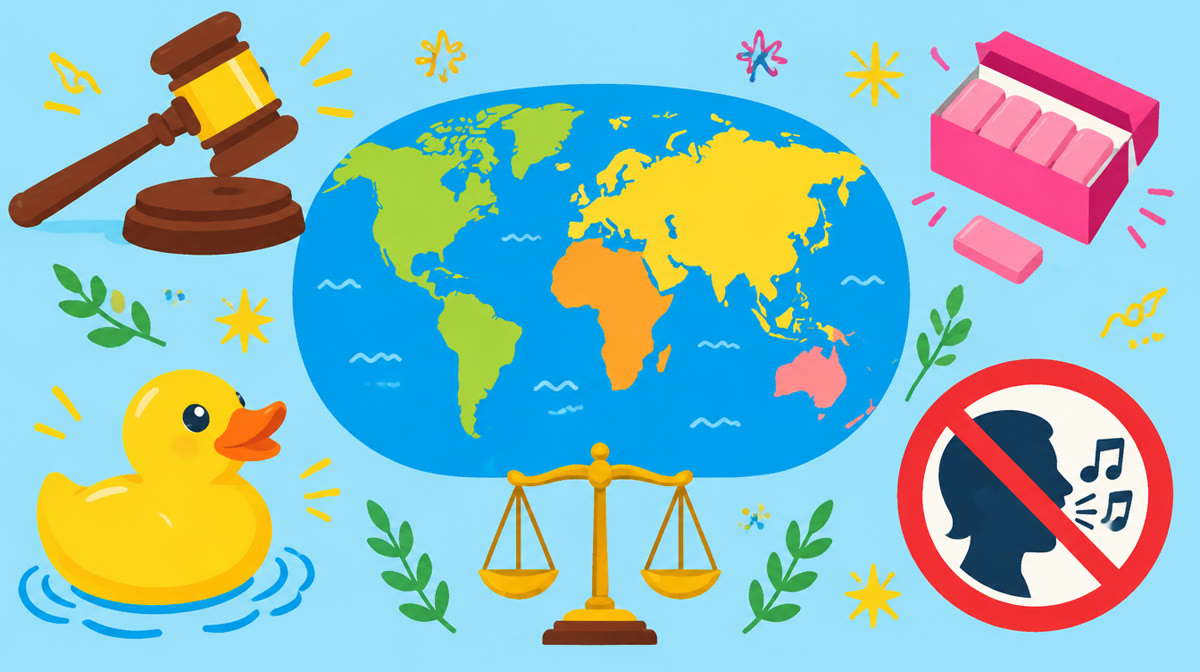
Many countries retain laws that sound bizarre by modern standards, often because they were passed to address a specific problem long since forgotten or never formally repealed. Reviewing these statutes offers a window into past social concerns, even when enforcement today is rare or non-existent.
Singapore's chewing gum restrictions
Singapore has restricted the sale of chewing gum since 1992, largely because discarded gum was causing maintenance problems in public housing and transit systems, including interference with train door sensors. Exceptions exist for gum with therapeutic or dental value sold through pharmacies, and the rule remains a widely cited example of Singapore's strict approach to public order.
Naming laws in several countries
Countries including Germany, Iceland and Denmark maintain official rules restricting what parents can legally name a child, often requiring names to indicate gender clearly or appear on an approved list. Icelandic naming law has historically required names to fit Icelandic grammar and tradition, with a national committee reviewing disputed cases.
A rule that sounds trivial today often began as a response to a very real administrative or public problem.
- Venice restricts feeding pigeons in St Mark's Square to protect historic buildings from droppings.
- Several jurisdictions have specific rules regulating how citizens must dispose of certain items.
- Some places require permits for activities that might otherwise seem entirely ordinary.
- Historical statutes sometimes remain technically active even when rarely enforced.
Old English laws that linger in memory
Popular lists frequently claim England retains laws such as a ban on dying in the Houses of Parliament, though such claims are usually exaggerated or entirely fabricated urban legends rather than verified statutes. Genuine historical laws, by contrast, such as various local bylaws, are usually easy to verify through official government archives.
Alcohol and Sunday trading rules
A number of jurisdictions, including parts of the United States, retain so-called blue laws restricting alcohol sales on Sundays, tracing back to religious observance traditions. Some of these laws have been repealed or loosened over recent decades as social attitudes and local economies shifted, though variation between neighbouring counties or states can still be significant.
- Blue laws historically also restricted various forms of commerce and entertainment on Sundays.
- Enforcement of unusual local laws often depends heavily on local authorities' priorities.
- Legal systems periodically conduct reviews to formally repeal outdated statutes.
- Tourist guides sometimes exaggerate obscure laws for entertainment value, so verification matters.
Why obscure laws persist
Repealing legislation takes legislative time and political will, so laws addressing minor or resolved problems can simply remain dormant on the books for decades. Full legal reviews are periodically conducted in some jurisdictions specifically to clear out obsolete statutes, though the process is slow and rarely a governmental priority.
Strange laws are a reminder that legislation reflects the specific anxieties of its era. What seems arbitrary today may have solved a genuine civic problem generations ago, even if the underlying issue has long since faded from public concern.
Shop this topic on Amazon
As an Amazon Associate we earn from qualifying purchases.
Test yourself on this topic

Global Knowledge · 12 questions
World Capitals Quiz: 12 Countries, 12 Capital Cities
The capitals people get wrong most often, spread across five continents. Twelve questions, no repeats.
Nature · 12 questions
National Parks Quiz: Landscapes, Wildlife and Firsts
Geysers, canyons, rainforests and the world's oldest protected parks. Twelve questions.
Comments
Share your score, argue with a question or add a fact we missed. Comments are checked before they appear, and links are removed automatically.
- No comments yet. Be the first.