

Male Pit Bull vs. Male Cougar: Who Has the Advantage?
Animals · 6 min read · 10/29/2026
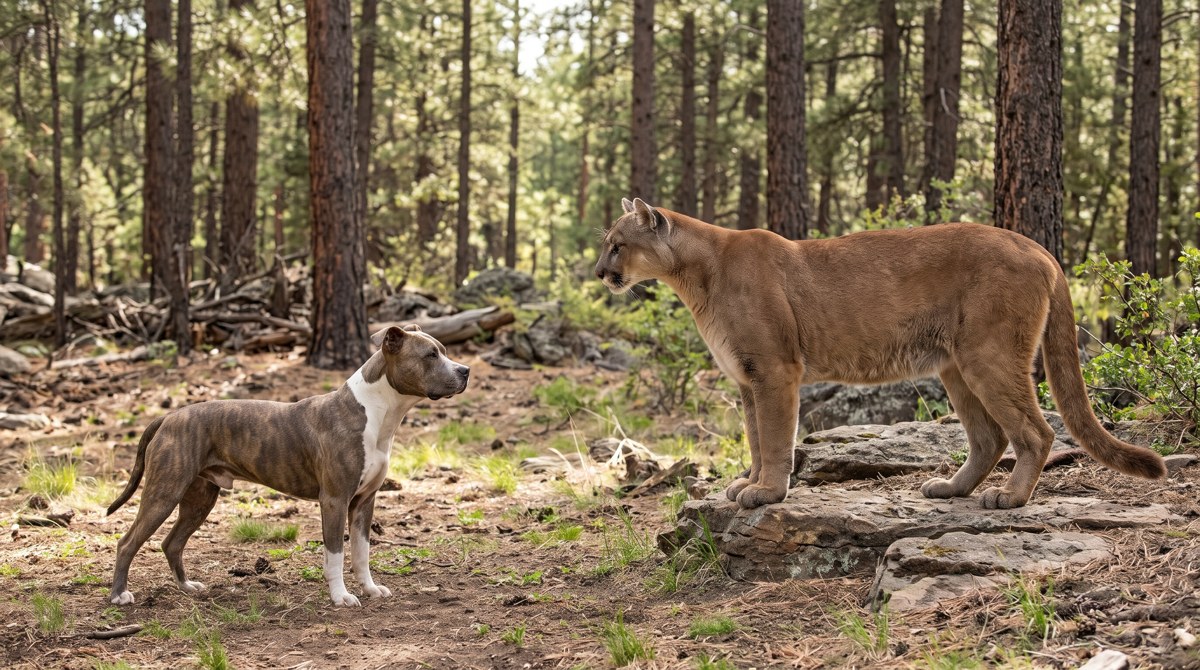
AI-generated editorial illustration, not a documentary image.
A fully grown male cougar would generally have the physical advantage over a fully grown male American Pit Bull Terrier, especially in body mass and predatory anatomy. That makes the cougar the more defensible hypothetical pick—not a guaranteed fight result. “Pit bull” is also an ambiguous label, and individuals vary. This is a sourced comparison of animals, not encouragement to stage a fight or use a dog to confront wildlife.
The clearest way to answer is to define the dog, compare named reference ranges and state the limits. Stories about unusually large dogs or a dramatic encounter cannot establish a universal winner. Equally, a dog’s reputation is not a measurement of its size or a substitute for understanding a wild cat. The practical outcome of this comparison should be safer decisions for people, pets and cougars.
What counts as a pit bull in this comparison?
Here the baseline is the American Pit Bull Terrier, a defined breed described by the United Kennel Club. In everyday usage, “pit bull” can refer to several breeds or mixes judged by appearance. Research on shelter dogs has found inconsistent visual identification of pit bull-type dogs. That makes an unspecified label a weak basis for an exact anatomical comparison.
The UKC standard gives a desirable adult-male weight of 35–60 pounds, approximately 16–27 kilograms. That is breed-standard guidance, not a measured population average, an absolute limit or a claim that every dog described as a pit bull fits it. For a particular animal, actual weight and health matter more than a nickname or a photograph.
A male cougar is usually a much larger animal
The National Park Service’s Bighorn Canyon mountain-lion page gives adult males at 120–200 pounds, approximately 54–91 kilograms. That is a regional wildlife reference range, not a universal specification for all cougar populations. It is still a useful comparison with the named dog standard: the listed cougar weights are substantially higher than the listed desirable dog weights.
| Feature | American Pit Bull Terrier | Cougar |
|---|---|---|
| Identity | Defined domestic dog breed | Wild cat, Puma concolor |
| Published weight reference | Desirable 35–60 lb / about 16–27 kg | 120–200 lb / about 54–91 kg |
| Source | United Kennel Club breed standard | NPS Bighorn Canyon wildlife page |
| What the range means | Breed guidance; not every labeled dog | Regional reference; populations vary |
| Defensible size inference | Smaller in these cited ranges | Substantial mass advantage |
Those figures should not be converted into fabricated odds. They come from different kinds of source, not a head-to-head trial. A scientific comparison can describe a strong size advantage without pretending it measured the probability of victory. Weight alone is also not a complete outcome model: age, health, surprise, escape routes and the circumstances of contact matter.
Why anatomy favors the cougar—but cannot guarantee an outcome
Cougars are wild cats with retractable claws and a hunting style involving stalking and short bursts of speed. Their larger body and additional clawed limbs are relevant to the hypothetical. A domestic dog has its own strength and defenses, but calling it brave does not neutralize the predator’s physical advantages. None of this requires inventing a precise bite-force figure, a mythical “locking jaw” or a ranking of aggression across all dogs.
Cougar, puma and mountain lion are common names for the same species, Puma concolor. A mountain lion is not an African lion. That naming distinction helps prevent comparisons from quietly borrowing facts about a different big cat. Nor does the name imply that a cougar only lives on mountains: use the local wildlife agency’s habitat and encounter advice for the place you are visiting.
Why there is no responsible guaranteed winner
A fight would be dangerous and unpredictable for both animals. A likely physical advantage is not a promise that every confrontation follows the same script. There is no need to seek a staged test, share fighting tactics or judge an entire dog breed from a hypothetical. The more useful inference is that you should never rely on a dog as protection from a cougar, regardless of confidence in that dog.
Protect dogs before an encounter happens
- Keep dogs leashed and close where dogs are permitted; check local access rules.
- Never let a dog chase, approach or corner a cougar.
- Secure pets, particularly at night, and reduce wildlife attractants around the home.
- Follow local agency guidance for reporting threatening behavior or pet losses.
Cougars are generally elusive and often avoid people, but that is not a reason to approach one. Wildlife agencies recommend securing pets and livestock and reducing attractants, including conditions that draw prey such as deer close to homes. Prevention is better than discovering whether a dog can defend itself during a surprise encounter.
What to do if you see a mountain lion
National Park Service guidance for people says not to approach or run. Face the animal, remain upright, appear larger and give it an escape route; retreat slowly when safe. Keep children close and avoid bending or crouching. If a cougar physically attacks a person, fight back rather than play dead. This is human emergency guidance, not a strategy for sending a dog into contact with wildlife. Call emergency services if there is immediate danger.
The bottom line is straightforward: the adult male cougar generally has the physical advantage in this comparison, but there is no guaranteed fight outcome. The real-world goal is no fight at all. Defined terms, sourced size ranges and local wildlife precautions are more useful than sensational claims about which animal is “unstoppable.”
Cougar and pit bull comparison: facts and safety
Question 1 of 10
What is the cougar’s scientific name?
Sources & further reading
Sources checked for this article’s publication on October 29, 2026. Study figures retain their original publication dates.
- United Kennel Club — American Pit Bull Terrier breed standard
- National Park Service — Bighorn Canyon mountain-lion size and anatomy
- Olson et al. — inconsistent visual identification of pit bull-type dogs
- National Park Service — mountain-lion encounter safety
- California Department of Fish and Wildlife — mountain-lion conflict prevention
Shop this topic on Amazon
As an Amazon Associate we earn from qualifying purchases.
Test yourself on this topic

Comments
Share your score, argue with a question or add a fact we missed. Comments are checked before they appear, and links are removed automatically.
- No comments yet. Be the first.