
Fun Facts About the Human Body That Are Actually True
Nature · 9 min read · 4/3/2026
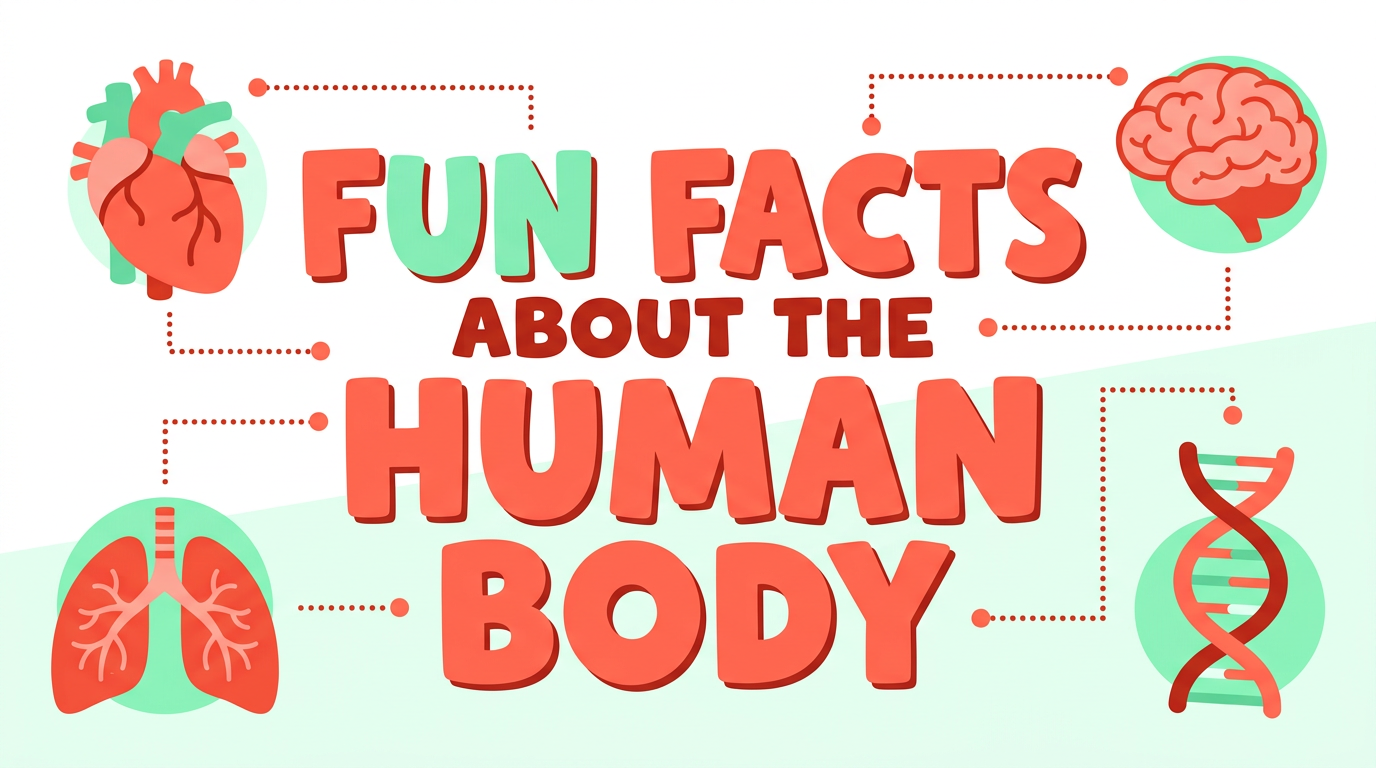
Human body trivia is unusually polluted with confident nonsense. Figures get repeated in classrooms for decades after being corrected, and some of the most familiar claims come from single studies that were never replicated. This piece sticks to the well-supported facts and flags the popular claims that do not hold up.
You have fewer bones than you were born with
An adult skeleton has 206 bones. A newborn has closer to 270, because many bones begin as separate pieces of cartilage and bone that fuse during childhood and adolescence. The skull is the clearest example: the plates are separate at birth to allow the head to pass through the birth canal and to accommodate rapid brain growth, and they knit together over the first years of life.
You are substantially microbial
The widely repeated claim that bacterial cells outnumber human cells ten to one came from a rough estimate that circulated for decades. Better estimates put the ratio closer to one to one, with roughly comparable numbers of bacterial and human cells. That is still a remarkable figure: a healthy body hosts a microbial population of the same order of magnitude as its own cells, concentrated overwhelmingly in the gut.
- Gut microbes help digest food, produce certain vitamins and interact with the immune system.
- By mass the microbiome is small, a matter of a couple of hundred grams, because bacterial cells are far smaller than human ones.
- Microbial composition varies enormously between individuals and shifts with diet, medication and illness.
Myths worth retiring
Several of the most repeated body facts are simply wrong, and they persist because they are memorable.
- You do not use only ten percent of your brain. Imaging shows activity throughout the brain, with different regions active for different tasks.
- The tongue does not have separate zones for each taste. Taste receptors for all basic tastes are distributed across the tongue.
- Hair and nails do not keep growing after death; surrounding tissue retracts, which makes them appear longer.
- Cracking your knuckles has not been shown to cause arthritis; the sound is gas bubbles collapsing in joint fluid.
The scale of the small stuff
Laid end to end, the blood vessels in an adult body would stretch a distance usually estimated in the tens of thousands of kilometres, most of it capillaries thin enough that red blood cells pass through in single file. The lungs contain hundreds of millions of alveoli, giving a gas-exchange surface area far larger than the body that holds it. These numbers are estimates rather than measurements, but the order of magnitude is well established.
The body's most impressive statistics all come from packing enormous surface area into very little space.
Healing runs on its own timetable
Different tissues replace themselves at wildly different rates. The lining of the gut turns over in days. Skin cells are replaced over weeks. Bone remodels continuously but slowly, which is why fractures take months rather than weeks to regain full strength. Some cell types, including most neurons in the brain, are largely with you for life, which is why nerve injuries recover so differently from skin injuries.
Sleep is maintenance, not downtime
Sleep is an active process. Memory consolidation, hormone regulation and clearance of metabolic waste from brain tissue all depend on it, which is why sustained sleep deprivation degrades attention, mood and immune function measurably. The specific mechanisms are still being researched, but the consequences of losing sleep are among the best-replicated findings in the field.
If you enjoy this kind of thing, our animal superpowers article covers the same ground for the rest of the animal kingdom.
Shop this topic on Amazon
As an Amazon Associate we earn from qualifying purchases.
Test yourself on this topic
Animals · 12 questions
Animal Oddities Quiz: 12 Facts That Sound Made Up
Twelve questions about record breakers, strange defences and animals whose reputations are entirely wrong.
Fun Math Tests · 12 questions
Fun Math Test: 12 Quick Puzzles, No Calculator
Mental arithmetic, number patterns and classic puzzles, each with the shortcut explained afterwards.
Comments
Share your score, argue with a question or add a fact we missed. Comments are checked before they appear, and links are removed automatically.
- No comments yet. Be the first.