
Engineering Marvel Facts Behind Iconic Structures
Global Knowledge · 9 min read · 9/15/2026
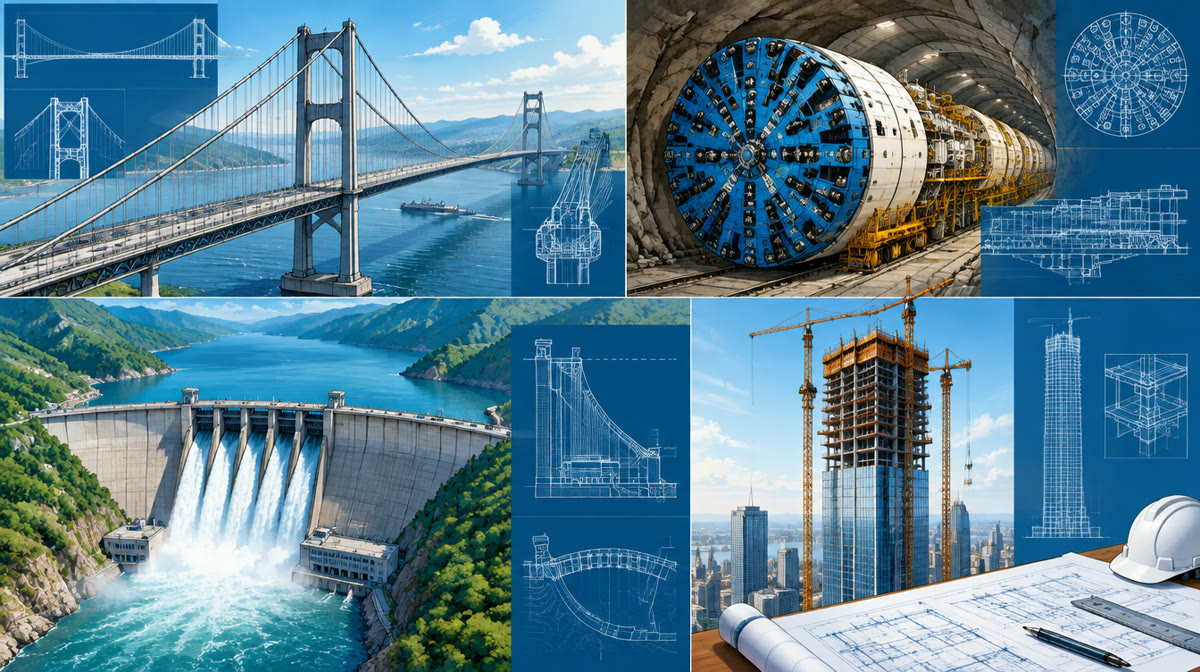
Iconic structures often draw attention for their height, length or visual design, but the more remarkable achievement is usually hidden: the engineering decisions that keep them stable, safe and functional under enormous stress. Understanding those decisions reveals genuine ingenuity behind buildings and infrastructure often taken for granted.
Skyscrapers are designed to sway
Tall buildings are engineered to flex slightly in strong winds rather than remain perfectly rigid, since a completely stiff structure would be more prone to catastrophic failure under stress. Some skyscrapers, including Taipei 101, incorporate a massive tuned mass damper, a huge suspended weight that counteracts building sway during strong winds or earthquakes.
The Golden Gate Bridge accounts for its own expansion
The Golden Gate Bridge, completed in 1937, includes expansion joints allowing its roadway to lengthen and contract with temperature changes, since steel structures naturally expand in heat and contract in cold. Without such joints, thermal stress could cause serious structural damage over repeated seasonal cycles.
Great engineering often looks effortless specifically because it accounts for forces most observers never consciously notice.
- The Golden Gate Bridge's distinctive orange colour, officially named International Orange, was chosen partly for visibility in San Francisco's frequent fog.
- The Burj Khalifa, completed in 2010, remains the tallest building in the world.
- The Channel Tunnel, connecting England and France, opened in 1994 and runs partly beneath the seabed.
- The Panama Canal, completed in 1914, uses a lock system to raise and lower ships between sea levels.
Ancient engineering still puzzles researchers
Structures like Rome's Pantheon, completed around 126 CE, still hold the record for the largest unreinforced concrete dome in the world, built using a Roman concrete recipe that included volcanic ash, a formulation modern researchers have studied for its unusual durability. Some ancient Roman concrete structures have proven more resistant to certain forms of long-term degradation than some modern equivalents.
Earthquake-resistant design saves lives
Modern seismic engineering uses techniques like base isolators, flexible supports that allow a building's foundation to move somewhat independently from the structure above during an earthquake, significantly reducing damage. Japan, situated in a highly seismically active region, has been a global leader in developing and mandating such earthquake-resistant building technologies.
- Base isolation systems can reduce the force transmitted from ground shaking to a building's structure.
- The Millau Viaduct in France, completed in 2004, is one of the tallest bridges in the world.
- Some modern skyscrapers include tuned liquid dampers, using large water tanks instead of solid weights.
- Underwater tunnels must account for immense water pressure and potential flooding risks during construction.
Infrastructure as invisible achievement
The most successful engineering often becomes invisible to the public precisely because it works reliably; people rarely think about the physics keeping a bridge standing or a tunnel dry unless something goes wrong. That quiet reliability is itself among engineering's greatest and least appreciated accomplishments.
Studying these marvels shows that impressive scale alone does not make a structure remarkable; the careful, often unseen calculations addressing wind, temperature, seismic activity and material stress are what actually keep these landmarks standing for generations.
Shop this topic on Amazon
As an Amazon Associate we earn from qualifying purchases.
Test yourself on this topic
Global Knowledge · 12 questions
World Capitals Quiz: 12 Countries, 12 Capital Cities
The capitals people get wrong most often, spread across five continents. Twelve questions, no repeats.

Nature · 12 questions
National Parks Quiz: Landscapes, Wildlife and Firsts
Geysers, canyons, rainforests and the world's oldest protected parks. Twelve questions.

Global Knowledge · 12 questions
Space Missions Quiz: From Sputnik to Artemis
Test your knowledge of the missions, astronauts and robotic explorers that transformed our view of space.
Comments
Share your score, argue with a question or add a fact we missed. Comments are checked before they appear, and links are removed automatically.
- No comments yet. Be the first.