
Deep Ocean Mysteries Scientists Are Still Solving
Nature · 9 min read · 9/15/2026
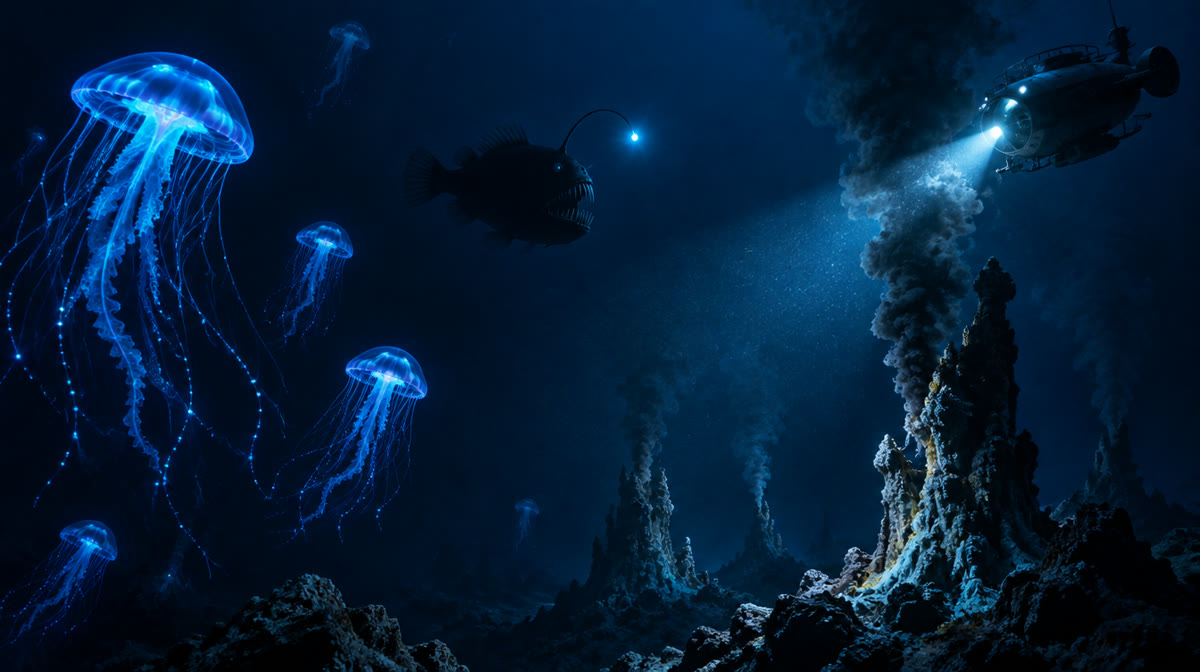
Although satellites have mapped the surface of Mars and the Moon in remarkable detail, large portions of Earth's own ocean floor remain unexplored. The deep sea's crushing pressure, total darkness and freezing temperatures make it one of the most difficult environments on the planet to study directly.
Most of the seafloor remains unmapped in detail
Despite decades of oceanographic research, a large share of the global ocean floor has not been mapped at high resolution, with much of the existing data derived from satellite gravity measurements rather than direct sonar surveys. International initiatives like the Seabed 2030 project aim to produce a complete high-resolution map, but the task remains far from finished.
Life thrives without sunlight
Hydrothermal vents, discovered in 1977 near the Galápagos Islands, support entire ecosystems based on chemosynthesis rather than photosynthesis, where bacteria convert chemicals like hydrogen sulfide into energy. Tube worms, crabs and shrimp cluster around these vents, thriving in conditions once thought incompatible with complex life.
Finding thriving ecosystems near scalding vents forced scientists to rethink where life could possibly exist, both on Earth and elsewhere.
- Hydrothermal vent fluid can reach temperatures over 300 degrees Celsius.
- Chemosynthetic bacteria form the base of the food web around deep vent ecosystems.
- The discovery of vent ecosystems has influenced theories about the possible origin of life.
- Similar vent-based ecosystems are now considered possible on icy moons like Europa.
Bioluminescence is remarkably common
An estimated majority of deep-sea species can produce their own light through bioluminescence, using it for hunting, camouflage or communication in an environment with essentially no sunlight below a certain depth. The anglerfish's glowing lure is among the most famous examples, attracting prey directly toward its mouth.
The deepest point remains difficult to reach
The Challenger Deep, located in the Mariana Trench, reaches depths of nearly 11,000 metres, deeper than Mount Everest is tall. Only a small number of crewed missions have ever reached the bottom, beginning with the Trieste in 1960 and including filmmaker James Cameron's solo dive in 2012.
- Pressure at the Challenger Deep exceeds 1,000 times normal atmospheric pressure at sea level.
- The Trieste's 1960 dive was piloted by Jacques Piccard and Don Walsh.
- Modern uncrewed submersibles now conduct much of the ongoing deep-sea exploration.
- New species continue to be discovered during deep-sea expeditions almost every year.
Why deep-sea exploration matters
Beyond scientific curiosity, understanding deep ocean ecosystems informs climate research, since the deep sea plays a major role in carbon storage and ocean circulation. Mining interest in deep-sea mineral deposits has also raised concerns about disturbing ecosystems that scientists have barely begun to study.
The ocean's depths remain one of the last true frontiers on Earth, and each expedition tends to raise as many new questions as it answers, ensuring deep-sea research will remain active for a very long time.
Shop this topic on Amazon
As an Amazon Associate we earn from qualifying purchases.
Test yourself on this topic
Animals · 12 questions
Ocean Giants Quiz: The Biggest Animals in the Sea
Blue whales, whale sharks, giant squid and more. Twelve questions on the ocean's largest residents.

Global Knowledge · 12 questions
Space Missions Quiz: From Sputnik to Artemis
Test your knowledge of the missions, astronauts and robotic explorers that transformed our view of space.

Nature · 12 questions
National Parks Quiz: Landscapes, Wildlife and Firsts
Geysers, canyons, rainforests and the world's oldest protected parks. Twelve questions.
Comments
Share your score, argue with a question or add a fact we missed. Comments are checked before they appear, and links are removed automatically.
- No comments yet. Be the first.