
Coffee Facts and Myths People Still Get Wrong
Pop Culture · 8 min read · 9/15/2026
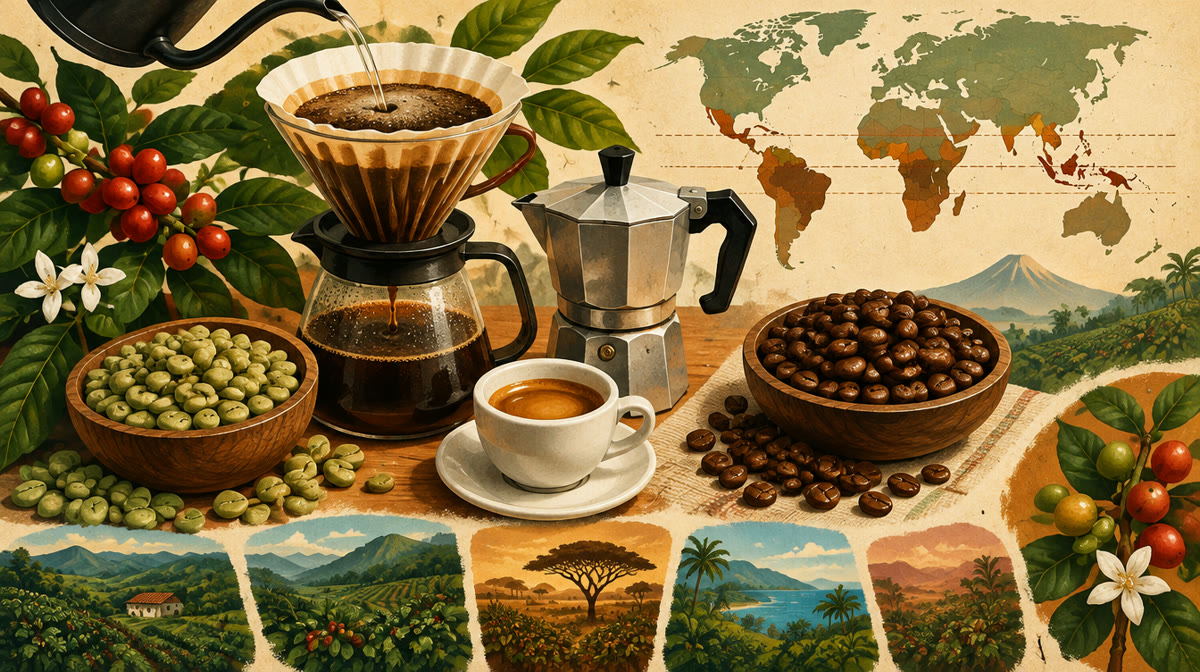
Coffee is one of the most widely consumed beverages in the world, yet many popular claims about its origins, chemistry and health effects are exaggerated, outdated or simply wrong. Separating documented history from popular legend clarifies what actually makes coffee such a globally significant crop and drink.
The goat-herder legend is likely folklore
A popular story credits an Ethiopian goat herder named Kaldi with discovering coffee after noticing his goats became energetic after eating coffee cherries. While charming, historians generally treat this tale as a much later folk legend rather than a documented historical account, since the earliest reliable written records of coffee cultivation and drinking come from Sufi monasteries in Yemen around the 15th century.
Decaf still contains some caffeine
Decaffeinated coffee is not entirely caffeine-free; the decaffeination process typically removes around 97 percent of caffeine, leaving a small residual amount per cup. This means decaf is not a fully caffeine-free option, though it is significantly lower than regular coffee for most sensitive drinkers.
Removing almost all caffeine is not the same as removing every trace, a distinction that matters for genuinely caffeine-sensitive drinkers.
- Common decaffeination methods include the Swiss Water Process and solvent-based extraction.
- Coffee cherries contain seeds, commonly called beans, that are roasted after processing.
- Arabica and Robusta are the two most commercially significant coffee species.
- Robusta beans generally contain roughly double the caffeine of Arabica beans.
Dark roasts are not automatically stronger in caffeine
A common misconception holds that darker roasted coffee always contains more caffeine due to its bolder flavour. In reality, roasting slightly reduces caffeine content, and the difference between light and dark roasts by volume measurement is often minimal, since bean density changes during roasting in ways that can offset the small caffeine reduction.
Coffee's spread was tied to trade restrictions
For a period, the Yemeni port of Mocha controlled much of the international coffee trade, and authorities reportedly restricted the export of fertile coffee seeds in an effort to protect that trade advantage. Coffee cultivation eventually spread regardless, notably reaching Java and other regions through Dutch colonial trade networks during the 17th century.
- Coffeehouses in the Ottoman Empire and later Europe became important centres for social and intellectual exchange.
- Some 17th-century European coffeehouses were nicknamed 'penny universities' due to the ideas exchanged there for the price of a cup.
- Brazil emerged as a dominant global coffee producer beginning in the 19th century.
- Instant coffee was refined and popularized significantly during the World War II era due to demand for military rations.
Moderate coffee drinking has mixed but often favourable research
Numerous studies have associated moderate coffee consumption with various potential health benefits, though research findings vary and individual tolerance to caffeine differs significantly. Coffee's health effects depend heavily on quantity, preparation method and any additional ingredients like sugar or cream, so broad claims deserve some scepticism.
Coffee's global popularity rests on genuine chemistry and centuries of trade history, though its most charming origin stories are best enjoyed as folklore rather than verified fact.
Shop this topic on Amazon
As an Amazon Associate we earn from qualifying purchases.
Test yourself on this topic

Personality Tests · 12 questions
Which Snack Are You? Snack Personality Quiz
Twelve playful questions matching snack personalities to traits, moods and social styles. Pure fun.

Pop Culture · 12 questions
Fun Trivia Questions and Answers Quiz
Twelve fun trivia questions and answers across movies, music, food, animals and everyday oddities.
Global Knowledge · 12 questions
World Capitals Quiz: 12 Countries, 12 Capital Cities
The capitals people get wrong most often, spread across five continents. Twelve questions, no repeats.
Comments
Share your score, argue with a question or add a fact we missed. Comments are checked before they appear, and links are removed automatically.
- No comments yet. Be the first.