

Batman & Robin: 10 Behind-the-Scenes Facts
Movies · 7 min read · 11/8/2026
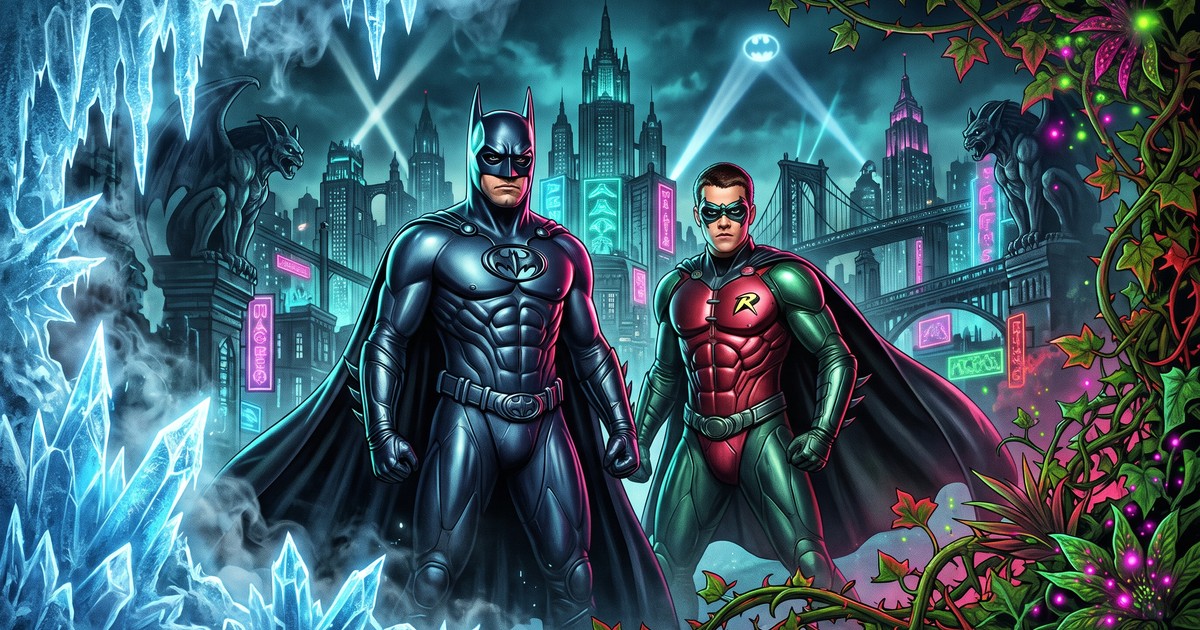
AI-generated editorial illustration inspired by the film’s neon Gotham, ice and botanical imagery.
Batman & Robin is remembered as the loudest, brightest and most divisive entry in the 1989–1997 Batman film series, but its behind-the-scenes story is much more interesting than a simple punchline. George Clooney’s only outing as Bruce Wayne combined a returning Robin, a new Batgirl, two major villains, a completely redesigned Batmobile, hundreds of visual-effects shots and some enormous practical machinery. The result did not land with most critics, yet the craft departments were attempting genuinely ambitious things.
Warner Bros. lists the film’s United States theatrical release as June 20, 1997. Twenty years later, The Hollywood Reporter assembled director Joel Schumacher and eight other people who worked on the production for an oral history. Their recollections are useful because they separate what was planned from what later became internet legend: this was not a small production that accidentally became excessive. It was a huge studio sequel deliberately pushed toward color, spectacle and merchandise-friendly imagery.
A new Batman arrived with a crowded call sheet
Val Kilmer did not return after Batman Forever, so George Clooney stepped into the cape and cowl. Chris O’Donnell remained as Dick Grayson/Robin, while Alicia Silverstone joined as Barbara Wilson/Batgirl. The villains were equally high-profile: Arnold Schwarzenegger played Mr. Freeze and Uma Thurman played Poison Ivy. That casting gave the film an unusual mix of television drama, action blockbuster, breakout comedy and art-house star power.
The Hollywood Reporter’s retrospective also preserves one of the strangest costume anecdotes. Schwarzenegger’s illuminated Mr. Freeze suit used batteries, and the oral history includes the recollection that battery acid leaked into the actor’s mouth during filming. It is best treated as a participant’s memory rather than a broader production statistic, but it captures how physically complicated the costumes could be.
The design brief was bigger, brighter and more toy-friendly
Schumacher and several collaborators later described pressure to make the sequel more “toyetic” — easier to translate into toys and other merchandise. That does not explain every creative choice, and it should not be turned into a claim that one note single-handedly created the finished film. It does, however, match what the production departments built: glowing vehicles, sculpted suits, oversized props, neon signs and sets designed to feel like a comic-book city rather than a realistic one.
Production designer Barbara Ling and cinematographer Stephen Goldblatt both returned from Batman Forever. Contemporary coverage of Goldblatt’s work says the team deliberately stopped worrying about whether every light source had a realistic explanation. Goldblatt even briefly considered the older, squarer Academy frame because it more closely resembled a comic-book panel before settling on the 1.85:1 widescreen format. The look was therefore not an accident: it was an approved visual strategy pushed much further than in the previous film.
The Batmobile became a rolling neon sculpture
Ling wanted the new Batmobile to feel larger than life after deciding that the Batman Forever car looked too small on screen. The 1997 vehicle was designed as an open-air machine inspired by classic racing roadsters such as the Jaguar D-Type and Delahaye 165. Vehicle historians credit TransFX/TFX with construction and report a length of about 30 feet, making it one of the longest screen Batmobiles despite having only one seat.
The details were just as theatrical. The car had illuminated wheels and engine panels, a counter-rotating turbine intake, six rear exhaust outlets arranged in a V pattern, custom 22-inch wheels and prototype Goodyear tires with the bat emblem cut into the tread. The same vehicle history reports that the practical car was road tested to 140 mph. Whether or not viewers like the design, it was not a simple prop shell; it was a functioning piece of automotive fabrication built to be photographed as a moving neon landmark.
Mr. Freeze’s telescope was a real mechanical giant
The film’s enormous Freeze telescope/weapon was not only a miniature or a digital extension. CALLICO Special Effects’ behind-the-scenes record describes a prop fabricated at the Spruce Goose Dome in Long Beach. Its listed specifications are startling: approximately 45 feet tall, 95,000 pounds overall, a barrel 65 feet long when extended, and a five-axis motion-control system covering rotation, vertical arms, barrel tilt, barrel extension and the diamond tray.
The same account says the machine used hydraulics supplied by two aircraft-style mobile units outside the dome. Operators could control it from three locations, with displays showing rotation counts, axis limits, pump controls and emergency-stop status. That is the sort of engineering detail modern viewers rarely associate with this film, but it helps explain why the set pieces have a physical presence even when the surrounding style becomes cartoonish.
The ice effects were early digital experimentation
VFX HQ credits visual-effects supervisor John Dykstra and a long list of effects houses, including Warner Digital Studios, Pacific Data Images, Rhythm & Hues, Cinesite and others. Its contemporary review counts more than 400 effects shots. They ranged from ice, vines and flowers to computer-generated stunt doubles used for falls and movements that could not be performed safely or convincingly by people.
The frozen-in-time moments were especially experimental. A later interview with lead CG artist Joel Merritt explains that Warner Digital used techniques related to photogrammetry and image-based modelling: actors and sets could be represented in three dimensions so the camera appeared to move through a suspended moment. The results look very much of their era, but they arrived years before audiences became accustomed to digital doubles and virtual cameras in superhero films.
| Detail | What happened | Why it matters |
|---|---|---|
| Casting | George Clooney replaced Val Kilmer, while Chris O’Donnell returned. | The sequel changed its lead without restarting the series. |
| Design | Barbara Ling and Stephen Goldblatt expanded the neon comic-book approach. | The look was a deliberate production strategy, not random decoration. |
| Batmobile | TransFX built an open-air car reported at about 30 feet long. | The vehicle was a functional fabrication, not merely a digital drawing. |
| Freeze telescope | The practical prop was listed at 45 feet tall and about 95,000 pounds. | Large mechanical filmmaking still carried major sequences. |
| Visual effects | VFX HQ counted more than 400 shots across many effects companies. | The film used early digital doubles and experimental frozen-moment techniques. |
Why the film’s reputation is only half the story
None of these details require pretending the finished movie worked. The dialogue, tone and character choices remain infamous, and the retrospective accounts describe a production pulled toward franchise and merchandise demands. Warner Bros. did not release another Batman film until Christopher Nolan’s Batman Begins in 2005, a gap that turned Batman & Robin into a cautionary tale about what happens when spectacle overwhelms story.
Still, the craft record deserves to be separated from the meme. The Batmobile team built a road-ready 30-foot machine. The effects crews fabricated a working telescope larger than many houses, lit an intentionally artificial Gotham and tested digital techniques that would become standard blockbuster tools. The movie’s failure is part of film history, but so is the scale of the work behind it. That tension is exactly what makes Batman & Robin such strong trivia material.
Batman & Robin production facts: 10 questions
Question 1 of 10
When did Warner Bros. release Batman & Robin in United States theaters?
Sources & further reading
Sources checked for this article’s publication on November 8, 2026. Study figures retain their original publication dates.
- Warner Bros. — Batman & Robin
- The Hollywood Reporter — Batman & Robin at 20 oral history
- Live Design — Stephen Goldblatt and the film’s Gotham lighting
- VFX HQ — Batman & Robin visual effects
- Batmobile History — the 1997 Batmobile
- CALLICO Special Effects — Mr. Freeze telescope fabrication
- vfxblog — the film’s frozen-moment effects
Shop this topic on Amazon
As an Amazon Associate we earn from qualifying purchases.
Test yourself on this topic
Movies · 12 questions
Superhero Movies Quiz: Marvel, DC and Beyond
Test your knowledge of superhero casting, cinematic universes, villains and box-office milestones.
Celebrities · 12 questions
Arnold Schwarzenegger Movies: I'll Be Back Quiz
Test your knowledge of Arnold Schwarzenegger's bodybuilding-to-blockbuster action career.
Comments
Share your score, argue with a question or add a fact we missed. Comments are checked before they appear, and links are removed automatically.
- No comments yet. Be the first.