
Arcade Era Facts From Gaming's Golden Age
Gaming · 8 min read · 9/15/2026
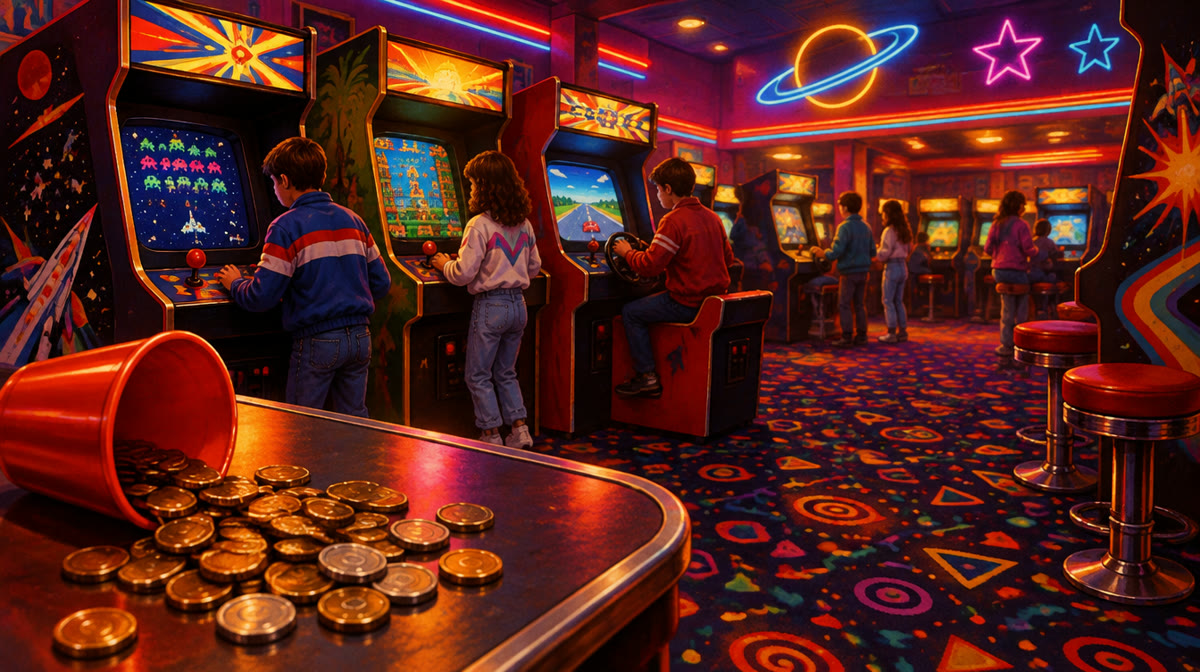
Before home consoles dominated living rooms, arcades were the beating heart of video game culture. Bright cabinets, competitive high score tables and coin-operated economics shaped how games were designed, since developers needed titles that could hook a player within seconds and profit from repeated short sessions.
Space Invaders and a coin shortage
Space Invaders, released by Taito in 1978, became so popular in Japan that persistent legend claims it caused a nationwide shortage of 100-yen coins. While the exact scale of the shortage has been debated by historians, the game's massive commercial success is well documented and it helped establish the arcade shooter genre worldwide.
Pac-Man was designed to appeal beyond typical players
Namco designer Toru Iwatani created Pac-Man in 1980 partly intending to attract female players to arcades, which were then dominated by combat and shooting games. Its non-violent maze chase and character-driven design helped it become one of the best-selling arcade games and an enduring pop culture icon.
An arcade cabinet had only a few seconds to convince a stranger to spend another coin, which forced designers toward instantly readable rules.
- Donkey Kong, released in 1981, marked Mario's first appearance under the name Jumpman.
- Street Fighter II, released in 1991, helped popularize competitive head-to-head fighting games in arcades.
- High score initials became an early form of public bragging rights before online leaderboards existed.
- Dance Dance Revolution, launched in 1998, brought physical rhythm gameplay into mainstream arcades.
Arcades shaped difficulty design
Because arcade revenue depended on repeated coin insertion, many games were deliberately difficult, ending runs quickly to encourage another play. This differed sharply from home console design, where developers could assume a player owned the game outright and had unlimited attempts, eventually shifting difficulty philosophy as consoles grew dominant.
Japan's arcade culture stayed strong longer
While arcades declined significantly in North America and Europe during the 1990s as home consoles improved, Japanese arcades, particularly those centred on fighting games, rhythm games and claw machines, remained a significant part of gaming and social culture for much longer, with dedicated arcade chains persisting well into the 2000s and beyond.
- Konami's Bemani series helped drive rhythm game popularity in Japanese arcades.
- Fighting game communities often formed directly around specific arcade cabinets and locations.
- UFO catcher claw machines became a widely recognized fixture of Japanese arcades.
- Some Japanese arcades combined gaming with other entertainment like karaoke and bowling.
A legacy beyond the cabinets
Arcade-era conventions, from lives and continues to high score chasing, still influence modern game design even though most people now play at home or on mobile devices. Retro arcade cabinets remain popular collector's items, and many classic titles have been re-released digitally for new generations of players.
The arcade era proved that a game did not need complex graphics to be gripping. It needed clear rules, quick feedback and just enough challenge to make one more coin feel worthwhile.
Shop this topic on Amazon
As an Amazon Associate we earn from qualifying purchases.
Test yourself on this topic
Gaming · 12 questions
Console History Quiz: 12 Questions on Gaming Hardware
Cartridges, discs, handhelds and the console wars. Twelve questions across five decades of gaming hardware.
Gaming · 12 questions
How Much Do You Know About Nintendo? 12-Question Quiz
From playing cards in 1889 to the Switch. Twelve questions on Nintendo's history, hardware and characters.

Pop Culture · 12 questions
Hard Pop Culture Quiz: Expert Level
Twelve genuinely difficult pop culture questions on film, music, TV and internet history.
Comments
Share your score, argue with a question or add a fact we missed. Comments are checked before they appear, and links are removed automatically.
- No comments yet. Be the first.