

Lab Mistakes Behind Everyday Objects
Technology · 4 min read · 11/3/2026
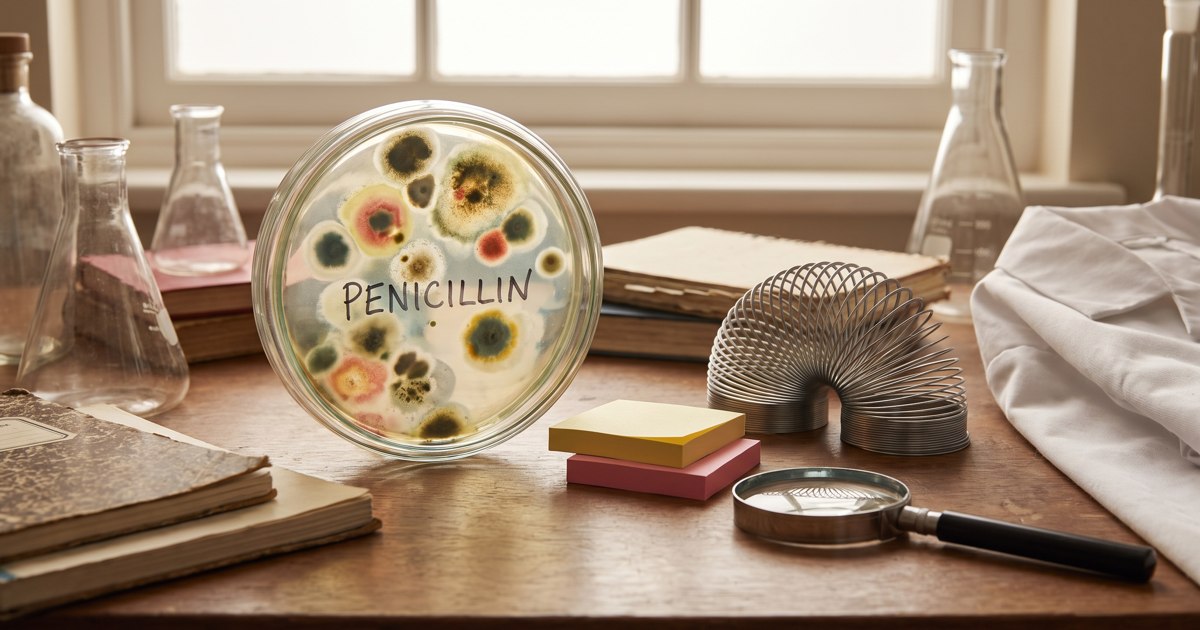
Innovation isn't always a meticulously planned process. Sometimes, the most groundbreaking discoveries arise from sheer serendipity – a forgotten experiment, a spilled chemical, or a failed attempt at something entirely different. This quiz delves into the world of 'accidental inventions,' focusing specifically on those born from laboratory mistakes, unexpected observations, or research gone awry. We'll explore how these 'happy accidents' transformed what were initially perceived as failures or curiosities into indispensable items that shape our daily lives. From kitchen appliances to office supplies and even medical breakthroughs, prepare to be surprised by the circuitous paths some of our most familiar objects took to become commonplace. These stories are a testament to the power of observation, critical thinking, and the willingness to see potential where others might only see a mess.
The Unsung Heroes of the Lab: Mistakes That Became Masterpieces
The popular image of invention often involves a brilliant mind meticulously planning and executing a groundbreaking idea. While many innovations indeed follow this path, an astonishing number of modern conveniences owe their existence to an entirely different, less glamorous process: the accidental discovery. These 'lab mistakes' range from overlooked petri dishes to curious observations of unintended side effects, proving that sometimes, the greatest leaps forward happen when things go wrong, or simply not as planned. The key, however, lies in the inventor's ability to recognize the potential in the unexpected.
From Melted Chocolate to Microwave Meals
One of the most famous tales of accidental invention belongs to Percy Spencer and the microwave oven. In 1945, Spencer, an engineer at Raytheon, was working on a magnetron – a vacuum tube used to generate microwave radio signals for radar. During an experiment, he noticed a candy bar in his pocket had melted. Intrigued, he placed popcorn kernels near the magnetron, watching them pop. Later, he tried an egg, which exploded. Spencer’s curiosity led him to design a metal box into which microwave power could be fed, effectively creating the first microwave oven. What began as a curiosity about a melted snack evolved into an appliance found in nearly every modern kitchen, fundamentally changing how we prepare food, and underscoring the importance of observing the unexpected in scientific research.
The Not-So-Strong Glue That Stuck Around
The ubiquitous Post-it Note also emerged from a failed experiment. In 1968, Dr. Spencer Silver, a scientist at 3M, was trying to develop a super-strong adhesive. Instead, he created a 'low-tack,' repositionable glue that wasn't very strong but could stick to surfaces without leaving residue and be peeled off repeatedly. Silver pitched his invention to colleagues, but it was largely seen as a failure for its intended purpose. It wasn't until six years later that Art Fry, another 3M scientist, saw the potential. Fry, frustrated by bookmarks falling out of his hymn book, remembered Silver's 'weak' adhesive. He applied it to paper, creating the first prototype of the Post-it Note. This story perfectly illustrates how a perceived failure in one context can be a groundbreaking success in another, given the right insight.
Slinky: A Spring That 'Walked'
The playful Slinky toy, a favorite for generations, was never intended to be a toy at all. In 1943, naval mechanical engineer Richard James was working at the William Cramp & Sons shipyards in Philadelphia, attempting to develop springs that could stabilize sensitive instruments aboard ships. One day, a spring accidentally fell from a shelf, and instead of simply dropping, it 'walked' down a stack of books, then onto the floor. James immediately recognized the entertainment potential in this unexpected motion. He took the spring home, and his wife, Betty, came up with the name 'Slinky.' The toy became an instant sensation, demonstrating how observation of an unexpected physical phenomenon can lead to an entirely new product category.
The Sweet Taste of Serendipity: Aspartame
Artificial sweeteners have a mixed reputation, but their discovery often shares a common thread: accidental tasting. Aspartame, one of the most widely used artificial sweeteners, was discovered in 1965 by James Schlatter, a chemist at G.D. Searle & Company. Schlatter was working on an anti-ulcer drug and, after synthesizing a new compound, accidentally licked his finger. He noticed a surprisingly sweet taste. The compound was aspartyl-phenylalanine methyl ester, which became known as Aspartame. This chemical 'accident' led to a multi-billion dollar industry and revolutionized the food and beverage sectors, providing a low-calorie sugar alternative.
Penicillin: A Moldy Miracle
Perhaps the most impactful accidental discovery in medical history is penicillin. In 1928, Scottish bacteriologist Alexander Fleming returned from a vacation to find his laboratory at St. Mary's Hospital Medical School in London in disarray. Among his uncleaned petri dishes containing Staphylococcus bacteria, he noticed something unusual: a mold had contaminated one dish, and around the mold, there was a clear ring where the bacteria had failed to grow. Fleming identified the mold as Penicillium notatum and realized it was producing a substance that killed bacteria. This chance observation led to the isolation of penicillin, ushering in the age of antibiotics and saving countless lives. Fleming's meticulous observation of a 'failed' experiment turned into one of the greatest medical breakthroughs.
FAQs About Accidental Inventions
Q: Are all accidental inventions 'mistakes'?
A: Not necessarily. While many involve an unforeseen outcome or a 'mistake' in an experiment, others are a result of observing an unexpected phenomenon or finding an entirely new application for something already known. The common thread is serendipity – finding something valuable when not actively looking for it in that specific context.
Q: What is the most significant accidental invention?
A: This is subjective, but penicillin is often cited as one of the most significant, given its profound impact on human health and its role in combating bacterial infections, leading to millions of lives saved worldwide. Other strong contenders include X-rays and the discovery of vulcanized rubber.
Q: What qualities do accidental inventors share?
A: Key qualities include keen observation, curiosity, an open mind to unexpected results, persistence, and the ability to connect seemingly unrelated observations to form a new idea or application. They don't just see a mistake; they see a new possibility.
Q: Do accidental inventions still happen today?
A: Absolutely! While modern research is highly structured, serendipity remains a powerful force in discovery. Many breakthroughs in materials science, medicine, and technology still arise from unexpected findings, failed experiments, or researchers noticing something 'odd' that warrants further investigation.
- The Slinky was originally a naval engineer's attempt to stabilize ship equipment.
- Post-it Notes came from a glue that wasn't strong enough for its intended purpose.
- The microwave oven was discovered when a radar engineer's candy bar melted.
- Penicillin was found when a mold contaminated a bacterial culture in a lab.
- Corn flakes were the result of a forgotten batch of boiled wheat.
- Aspartame's sweetness was discovered when a chemist accidentally licked his finger.
- X-rays were an unexpected emission from a cathode ray tube experiment.
- Petroleum jelly (Vaseline) was refined from a crude oil byproduct used by oil rig workers for healing.
Test what you learned
Question 1 of 10
Which common kitchen appliance was invented when a scientist accidentally melted a candy bar with microwave radiation?
Sources & further reading
Sources checked for this article’s publication on Invalid Date. Study figures retain their original publication dates.
Shop this topic on Amazon
As an Amazon Associate we earn from qualifying purchases.
Comments
Share your score, argue with a question or add a fact we missed. Comments are checked before they appear, and links are removed automatically.
- No comments yet. Be the first.