

True or False Space Quiz: Test Your Cosmic Knowledge
Global Knowledge · 7 min read · 10/6/2026
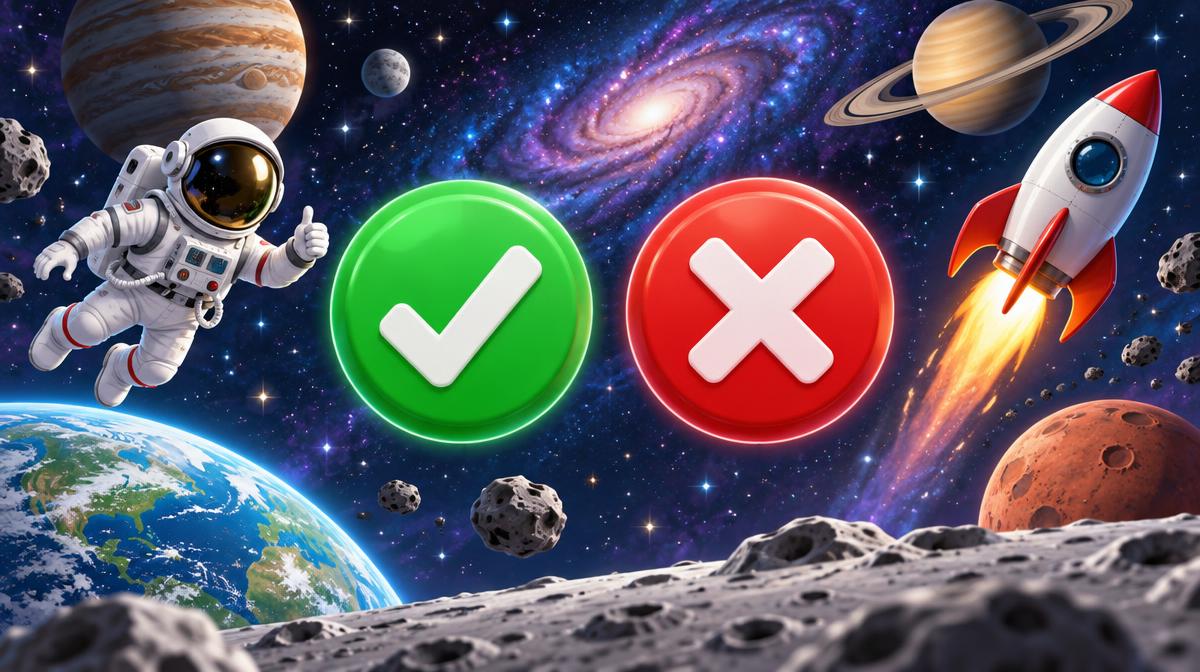
Embark on an exhilarating journey through the cosmos with our True or False Space Quiz! The universe is a vast and mysterious place, full of wonders that often challenge our understanding. From the swirling gas giants to the ancient light of distant stars, there's always something new to learn and often, a common misconception to debunk.
Space exploration has captivated humanity for centuries, pushing the boundaries of science and technology. This quiz isn't just about memorizing facts; it's about engaging with the awe-inspiring reality of our universe and separating scientific truth from popular fiction. Are you ready to put your cosmic knowledge to the ultimate test?
Unveiling the Universe: A True or False Challenge
The universe is an immense tapestry woven with stars, planets, galaxies, and phenomena that boggle the mind. Often, what we *think* we know about space can be influenced by science fiction or outdated information. This quiz will cover various aspects of astronomy and space science, challenging you to discern fact from fiction.
We'll delve into topics ranging from the characteristics of planets in our solar system to the mind-bending concepts of black holes and the expansion of the universe. Each question is designed to be thought-provoking, offering an opportunity to deepen your appreciation for the science behind the cosmos.
The Solar System: Our Cosmic Neighborhood
Let's start close to home, within our own solar system. While we've learned a tremendous amount about our planetary neighbors, there are still many surprising facts and persistent myths. Think you know Earth's closest companions inside and out?
Beyond Our Sun: Stars and Galaxies
Venturing further out, we encounter the incredible diversity of stars and the grand structures of galaxies. These celestial bodies operate on scales almost impossible for the human mind to fully grasp, yet scientists have uncovered astounding truths about their formation, life cycles, and interactions.
Cosmic Phenomena: Black Holes, Nebulae, and More
Then there are the truly exotic phenomena: black holes that devour light, nebulae that birth stars, and dark matter that invisibly dominates the universe's mass. These topics often spark the most curiosity and, consequently, the most misinformation. Prepare to have some common beliefs challenged!
Why Space Trivia Matters
Engaging with space trivia, especially in a true or false format, is more than just a fun pastime. It encourages critical thinking and a deeper understanding of the scientific method. By questioning what we believe to be true, we open ourselves to learning accurate, up-to-date information that reflects humanity's ongoing exploration and discovery.
Understanding space helps us appreciate our place in the universe. It fosters a sense of wonder and inspires future generations to pursue careers in STEM fields. Moreover, many technologies we use daily, from GPS to satellite communication, are direct results of space-related research and development.
The Allure of the Unknown
Part of space's enduring appeal is the sheer scale of the unknown. While we've made incredible strides, the vast majority of the universe remains a mystery. True or false questions can highlight what we *do* know with certainty, often juxtaposing it against popular, but incorrect, assumptions. This distinction is crucial for building a solid foundation of scientific literacy.
FAQ: True or False Questions About Space
Here's a sample of true or false questions to get you started, along with their answers and explanations.
- True or False: The Sun is a planet.
- False. The Sun is a star, specifically a yellow dwarf star, which is the center of our solar system and provides light and heat to Earth.
- True or False: There is no gravity in space.
- False. Gravity exists everywhere in space. Astronauts in orbit appear weightless because they are constantly falling around Earth, not because there's no gravity. The Moon, planets, and stars all exert gravitational pull.
- True or False: Mars is known as the "Red Planet" due to its rusty iron-rich soil.
- True. The surface of Mars is abundant in iron oxide, commonly known as rust, which gives the planet its distinctive reddish hue.
- True or False: The Earth is the largest planet in our solar system.
- False. Jupiter is the largest planet in our solar system, with a mass more than two and a half times that of all the other planets combined.
- True or False: A light-year is a measure of time.
- False. A light-year is a measure of distance, specifically the distance light travels in one Earth year, which is about 9.46 trillion kilometers (5.88 trillion miles).
- True or False: Pluto is no longer considered a planet.
- True. In 2006, the International Astronomical Union (IAU) reclassified Pluto as a "dwarf planet" because it has not cleared its orbital path of other debris, one of the criteria for full planethood.
- True or False: The Moon has a dark side that never sees sunlight.
- False. The Moon does not have a permanently dark side. It is tidally locked with Earth, meaning the same side always faces us, but all sides of the Moon experience sunlight as it orbits the Earth and rotates on its axis.
- True or False: The asteroid belt is located between Mars and Jupiter.
- True. The main asteroid belt is a torus-shaped region in the Solar System, located roughly between the orbits of the planets Mars and Jupiter.
- True or False: All stars are white.
- False. Stars come in various colors, which depend on their surface temperature. Hotter stars tend to be blue or white, while cooler stars can appear yellow, orange, or red.
- True or False: Sound travels faster in space than on Earth.
- False. Sound cannot travel in the vacuum of space because it requires a medium (like air or water) to propagate. On Earth, sound travels through the atmosphere.
- True or False: There are more stars in the universe than grains of sand on all Earth's beaches.
- True. While it's an estimate, scientists widely agree that the number of stars (around 10^22 to 10^24) far exceeds the number of sand grains on Earth (estimated around 10^20).
- True or False: Astronauts grow taller in space.
- True. In the microgravity environment of space, the spine elongates as the discs between vertebrae spread out, causing astronauts to temporarily grow a few centimeters taller. They return to their original height after returning to Earth.
- True or False: The Milky Way is the only galaxy in the universe.
- False. The Milky Way is just one of billions, possibly trillions, of galaxies in the observable universe. Our closest large galactic neighbor is the Andromeda Galaxy.
- True or False: A black hole is a vacuum cleaner that sucks up everything around it.
- False. While black holes have immense gravitational pull, they don't "suck" things up like a vacuum cleaner. Objects must cross an event horizon to be pulled in. Outside this boundary, their gravity behaves like any other massive object.
- True or False: Astronauts can cry tears in space, but the tears don't fall.
- True. In the absence of gravity, tears will form a ball and stick to the eye or float away rather than rolling down the cheek.
- True or False: Saturn is the only planet in our solar system with rings.
- False. While Saturn's rings are the most prominent and beautiful, Jupiter, Uranus, and Neptune also have ring systems, though they are much fainter and harder to observe.
- True or False: The observable universe is continually expanding.
- True. Observations show that the universe is not only expanding but that its expansion is accelerating, a phenomenon attributed to dark energy.
- True or False: The Big Bang was an explosion that happened at a central point in space.
- False. The Big Bang was not an explosion *in* space, but rather an expansion *of* space itself, occurring everywhere simultaneously, not from a single point within existing space.
- True or False: Earth's atmosphere protects us from all space radiation.
- False. While Earth's atmosphere and magnetic field do provide significant protection, some high-energy cosmic radiation can still penetrate, especially at higher altitudes or during solar events. Astronauts in space face much higher radiation exposure.
- True or False: Jupiter's Great Red Spot is a giant, persistent storm.
- True. The Great Red Spot is a massive anticyclonic storm that has been observed for centuries, larger than Earth, swirling in Jupiter's atmosphere.
Conclusion
How did you fare on our True or False Space Quiz? Whether you aced it or learned some surprising new facts, the journey through space is always an enlightening one. The universe holds countless wonders, and our understanding of it is constantly evolving with new discoveries.
Keep exploring, keep questioning, and keep looking up! The more we learn about the cosmos, the more we appreciate the intricate beauty and immense scale of our existence. Share this quiz with friends and family to see who among you is the ultimate space trivia champion!
Shop this topic on Amazon
As an Amazon Associate we earn from qualifying purchases.
Test yourself on this topic
Global Knowledge · 12 questions
Space Missions Quiz: From Sputnik to Artemis
Test your knowledge of the missions, astronauts and robotic explorers that transformed our view of space.
Nature · 12 questions
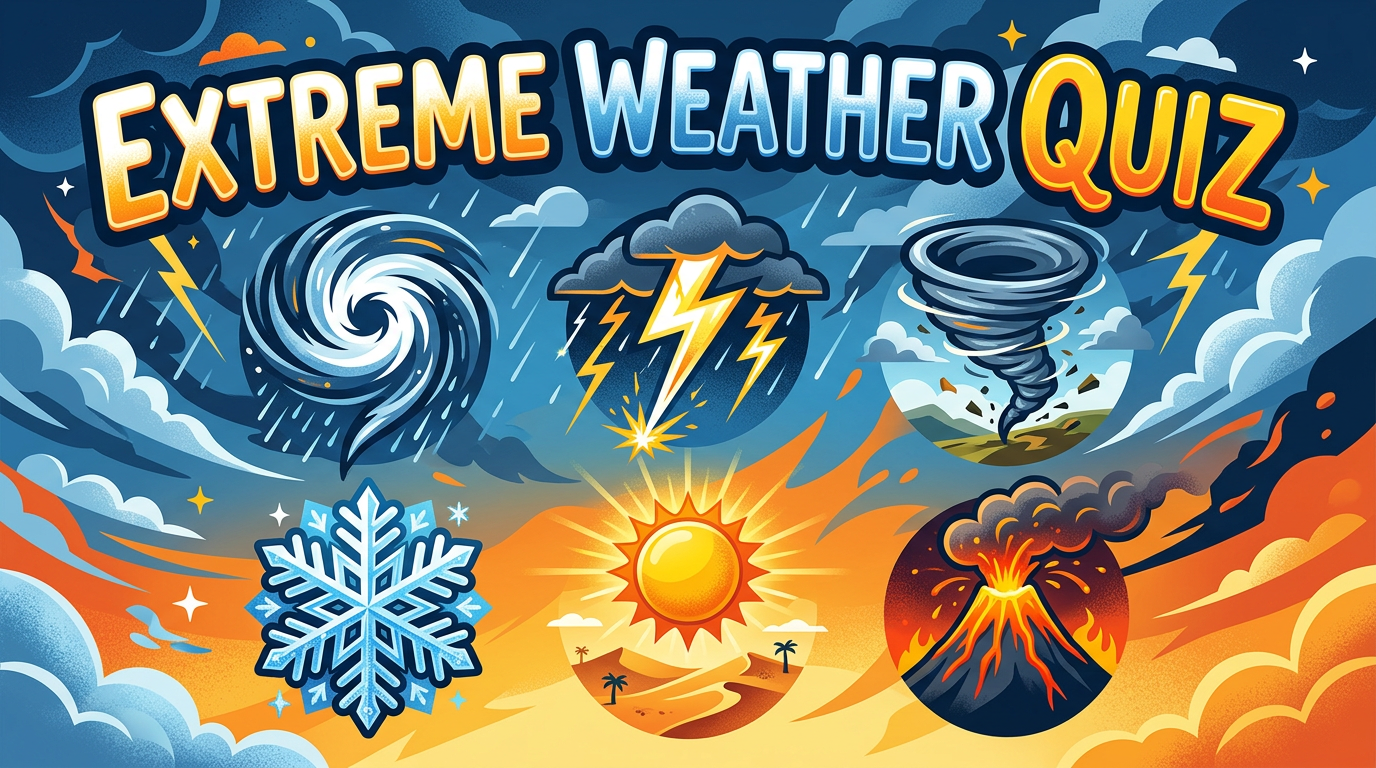
Extreme Weather Quiz: Storms, Records and Wild Skies
Hurricanes, tornado scales, hailstones and temperature records. Twelve questions about weather at its most dramatic.
Animals · 12 questions
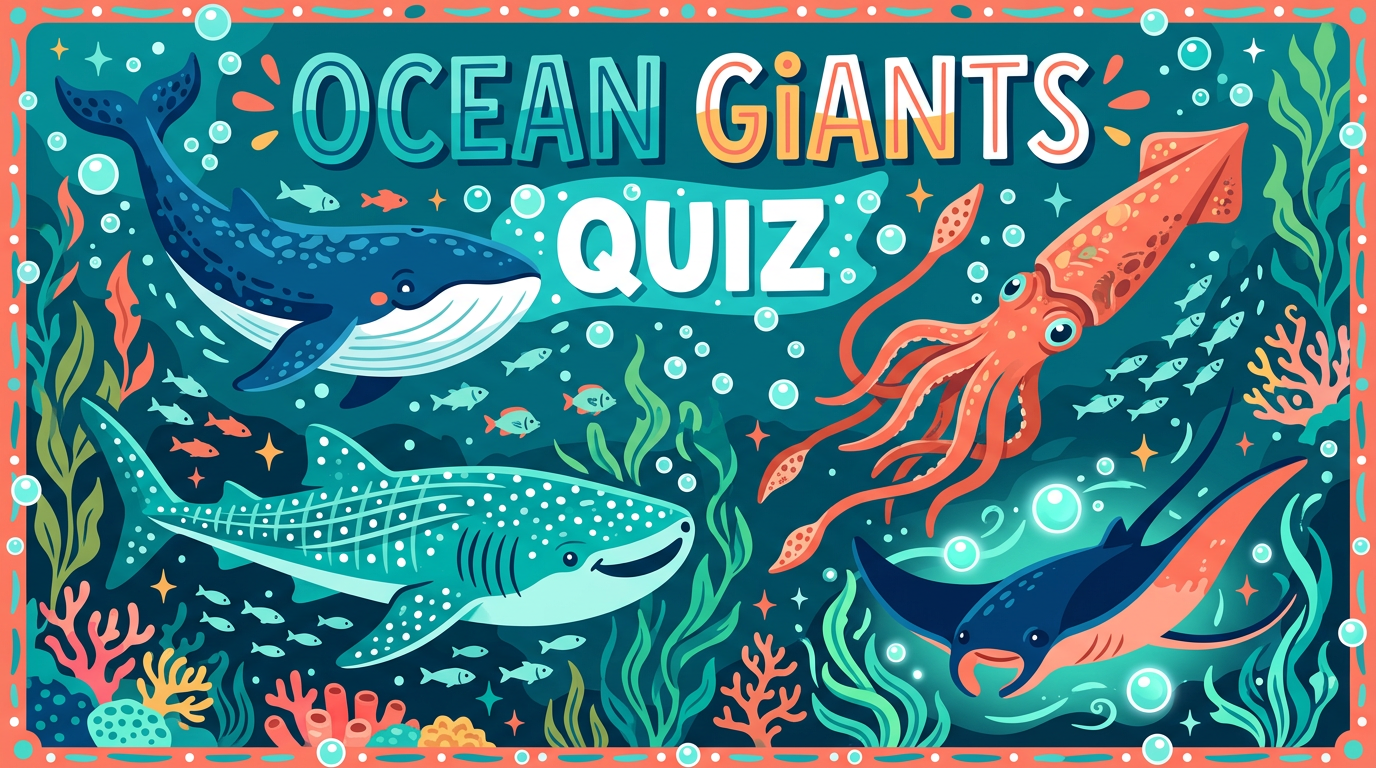
Ocean Giants Quiz: The Biggest Animals in the Sea
Blue whales, whale sharks, giant squid and more. Twelve questions on the ocean's largest residents.
Comments
Share your score, argue with a question or add a fact we missed. Comments are checked before they appear, and links are removed automatically.
- No comments yet. Be the first.