

How Many Hearts Does an Octopus Have? 25 Facts
Animals · 5 min read · 10/8/2026
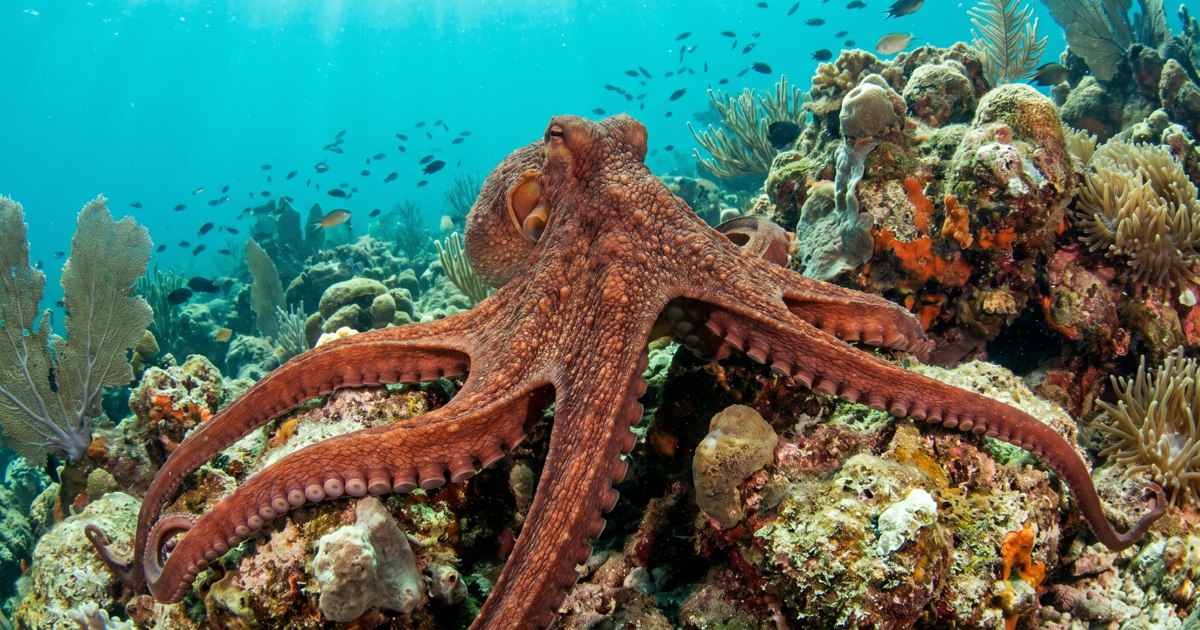
AI-generated cover illustration. Sources and study notes below.
An octopus has three hearts: two branchial hearts send blood through the gills, and one systemic heart circulates oxygenated blood to the rest of the body. That is the short answer. The longer answer leads into blue blood, arms that process sensory information and camouflage that changes more than colour. Here are that heart fact and 24 more, with species differences kept in view.
Hearts and blood: facts 1–5
The three hearts form one circulatory system. They are not three spare copies of a human heart, and an octopus does not simply switch one on if another fails.
- 1. An octopus has three hearts: two branchial hearts for the gills and one systemic heart for the body.
- 2. It has two gills, each served by a branchial heart.
- 3. Oxygenated octopus blood appears blue because it contains copper-based hemocyanin.
- 4. Humans use iron-containing hemoglobin instead; blue octopus blood is not caused by ink.
- 5. The systemic heart stops beating during swimming, making sustained jet-propelled swimming demanding.
Arms, senses and camouflage: facts 6–15
An octopus is a mollusc, but most familiar examples lack the hard external shell associated with a snail. Its flexible arms and skin make it exceptionally good at exploring, hiding and escaping.
- 6. Octopuses have eight arms; they are not the same arrangement as a squid’s eight arms and two longer tentacles.
- 7. Suckers can grip objects and sense chemicals on surfaces, sometimes described as tasting by touch.
- 8. Many neurons are outside the central brain, particularly in the arms, allowing substantial local processing.
- 9. The popular phrase “nine brains” oversimplifies that distributed nervous system.
- 10. A hard beak lies at the mouth where the arms meet and helps break food apart.
- 11. The soft body can squeeze through narrow gaps, although the beak limits the smallest opening.
- 12. Chromatophores are pigment-containing skin structures involved in changing colour.
- 13. Some octopuses can also change skin texture, creating bumps that help match a rough background.
- 14. Their eyes have a camera-like arrangement, a striking case of similarity with vertebrate eyes despite separate evolutionary histories.
- 15. Many species eject ink as a defence, but not every octopus species has an ink sac.
Behaviour and life history: facts 16–25
Ability is not identical in every species or individual. Aquarium observations and experiments show useful capacities, but calling every octopus a genius can hide the specific behaviour scientists actually measured.
- 16. Octopuses are predators, and many feed on crustaceans and other small marine animals.
- 17. Jet propulsion expels water through a siphon; crawling is another important way to move.
- 18. Some octopuses have opened jars or solved tasks in controlled settings.
- 19. Veined octopuses have been observed carrying coconut shells for shelter, an example of tool use.
- 20. An octopus can regenerate a lost arm; regrowth takes time and is not invulnerability.
- 21. Males transfer sperm using a modified arm called a hectocotylus.
- 22. In many species females guard eggs, stop feeding and die after the reproductive period.
- 23. Lifespan varies, but many octopuses live only about one or two years.
- 24. Giant Pacific octopuses are among the largest species and can live longer than that short typical span.
- 25. Dumbo octopuses have ear-like fins and live in deep water; those “ears” are not mammalian hearing organs.
Are octopuses dangerous to touch?
Do not handle wildlife to test the facts. Octopuses have beaks and venom, and blue-ringed octopuses can cause life-threatening poisoning. Observing from a safe distance protects the animal as well as the visitor. Their regenerative ability is no excuse to injure one, and opening an aquarium lid is not a harmless intelligence experiment.
Three hearts does not mean three separate personalities
The circulation, nervous system and skin work together in a single animal. Likewise, neurons in an arm do not make it an independent animal. Clear definitions help explain what is truly extraordinary without converting metaphor into a biological claim.
How Many Hearts Does an Octopus Have? 25 Facts quiz
Question 1 of 10
How many hearts does an octopus have?
Sources & further reading
Editorial review: October 8, 2026. Calendar tools calculate dates automatically; study figures retain their original publication dates.
Shop this topic on Amazon
As an Amazon Associate we earn from qualifying purchases.
Comments
Share your score, argue with a question or add a fact we missed. Comments are checked before they appear, and links are removed automatically.
- No comments yet. Be the first.