
Oceans and Continents Trivia: 15 Geography Facts
World Geography · 5 min read · 11/17/2026
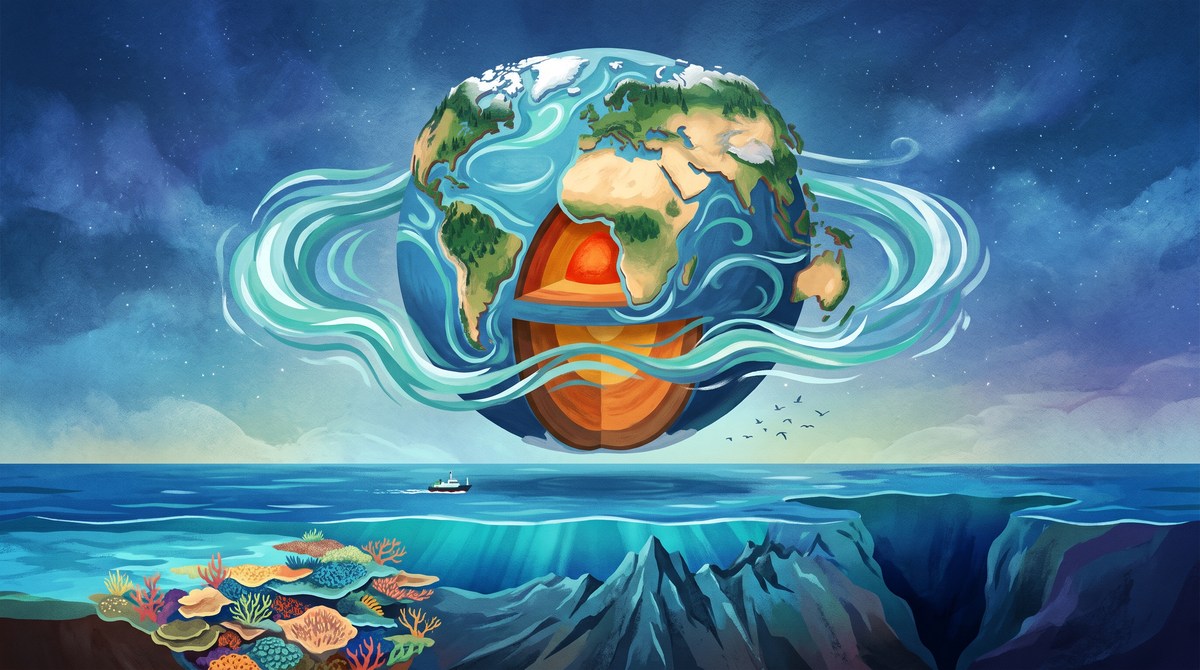
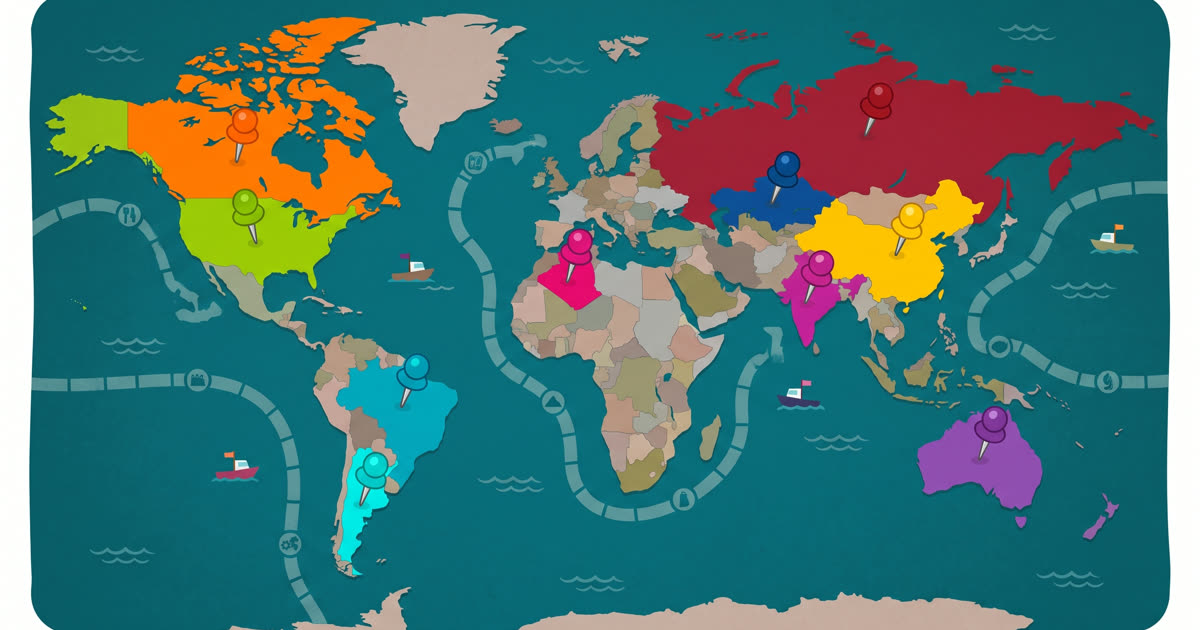
Original editorial illustration of Earth’s connected ocean and continental geography.
How many oceans and continents does Earth have? The familiar classroom answer is five oceans and seven continents, but both need a little explanation. The five named oceans are regions of one connected global ocean, and the seven-continent model divides some continuous landmasses along historical and cultural lines. Those details make better geography trivia than memorizing two lists without context.
There is one global ocean
NOAA describes a single global ocean covering about 71 percent of Earth’s surface. Its connected water holds more than 97 percent of the planet’s water. The Atlantic, Pacific, Indian, Arctic and Southern Oceans are useful named regions, not giant bathtubs with walls between them. The United States recognizes all five, although the proposed Southern Ocean boundaries have not been ratified by every member of the International Hydrographic Organization.
The five ocean regions are not equal in size
The Pacific is larger than the other four named regions by a wide margin. NOAA’s comparison gives it an area of about 166 million square kilometers, roughly 45 percent of all ocean area. The Atlantic follows at about 82 million square kilometers, then the Indian at 73.6 million. These figures describe ocean regions, not the territorial waters of the countries beside them.
| Ocean region | Square kilometers | Share of total ocean area |
|---|---|---|
| Pacific | 166,000,000 | 45.0% |
| Atlantic | 82,000,000 | 22.2% |
| Indian | 73,600,000 | 20.0% |
| Southern | 35,000,000 | 9.5% |
| Arctic | 12,173,000 | 3.3% |
Seven continents, with an important exception to the map
National Geographic’s seven-continent model lists Asia, Africa, North America, South America, Antarctica, Europe and Australia from largest to smallest. Together they account for about 148 million square kilometers of land. Yet Europe and Asia occupy one enormous landmass called Eurasia. Their separation reflects human history and cultural geography as much as physical geography.
Continental edges are not simply the line where a beach meets the water. A continental shelf is a gently sloping submerged extension of a continent. Nearby islands are also commonly assigned to a continent: Japan is part of Asia, while Greenland is generally included in North America. A flat political map hides those geological relationships.
The seafloor is not flat
NOAA’s Know Your Ocean program compares the seabed to land: it has plains, canyons and mountain ranges, including features larger than their counterparts above sea level. That makes the ocean a landscape rather than an empty blue space. The water also moves continuously through surface and deep currents, redistributing heat and affecting weather far from the coast.
Blue water is not simply reflected sky
The ocean can mirror the sky at its surface, but reflection is not the full explanation for its blue appearance. Water molecules scatter sunlight, and blue wavelengths are scattered strongly. Suspended sediment and tiny floating organisms can shift the apparent color toward green or other hues. Local depth, light and material in the water all affect what an observer sees.
The facts worth keeping
The shortest reliable summary is this: Earth has one connected ocean with five commonly named regions, and a widely used seven-continent model. The Pacific is the largest ocean region, Asia the largest continent, and Europe and Asia share the Eurasian landmass. Those answers are simple enough for a quiz, but now the reasoning behind them is part of the answer too.
Put your map knowledge to work in our Name the Continent game or take the longer Journey Across Continents Geography Quiz.
Oceans and continents: 10 questions
Question 1 of 10
How many connected global oceans does NOAA say Earth has?
Sources & further reading
Sources checked for this article’s publication on November 17, 2026. Study figures retain their original publication dates.
Shop this topic on Amazon
As an Amazon Associate we earn from qualifying purchases.
Test yourself on this topic
World Geography · 15 questions
World Geography Game: Name the Continent
A world geography game: we name the country, landmark or wonder, you pick its continent. 15 rounds, from Mongolia and Peru to Lake Victoria.
World Geography · 15 questions
Journey Across Continents Geography Quiz
Travel across all seven continents in one geography quiz: mountains, rivers, deserts, capitals and landmarks from Africa to Antarctica.
World Geography · 15 questions
World Large Countries Map Quiz Game: Biggest Nations
Can you place the world's biggest countries on the map? A 15-question large countries map quiz game covering size, borders and location.
Comments
Share your score, argue with a question or add a fact we missed. Comments are checked before they appear, and links are removed automatically.
- No comments yet. Be the first.