

Hardest Mushoku Tensei Lore Secrets
Anime · 7 min read · 10/24/2026
The Hidden Depths of the Six-Faced World
When author Rifujin na Magonote first conceived *Mushoku Tensei: Jobless Reincarnation*, he did not simply write a standard fantasy setting. He drafted a meticulously constructed universe governed by strict physical laws, deep historical generational divides, and intricate cosmology. While casual viewers recognize Rudeus Greyrat's journey through magic academies and continent-spanning travels, only dedicated scholars of the lore comprehend the subterranean history that dictates every disaster in the story.
Testing someone on the surface details of Roxy's hat or Sylphiette's hair color barely scratches the surface. The true challenge lies in the mechanics of the Six-Faced World, the metaphysical fallout of the ancient Dragon race, and the specific historical figures whose names are carved into stone across the central continent.
"In this world, effort actually pays off. That alone makes it worth giving everything I have."
The True Nature of the Six-Faced World
The cosmos of *Mushoku Tensei* is known formally as the Six-Faced World (Rokumen Sekai). Rather than a planetary sphere resting in outer space, the reality is shaped like a giant three-dimensional cube. Each of the six faces represented an entire dimensional realm ruled by an original patron deity:
- The Human World ruled by the Original Human God
- The Demon World ruled by the Original Demon God
- The Dragon World ruled by the Original Dragon God
- The Beast World ruled by the Original Beast God
- The Sea World ruled by the Original Sea God
- The Sky World ruled by the Original Sky God
Long before the events of the main narrative, five of the six faces collapsed in cataclysmic wars. The Original Dragon God defeated the other deities under mysterious circumstances, culminating in the destruction of five worlds. Only the Human World survived, absorbing remnants and survivors from the fallen dimensions. The barren Void between the faces became the eternal prison of the entity known as the Man-God, or Hitogami. Understanding this multi-dimensional slaughter is essential for grasping why the modern world features such a fragmented patchwork of races, ecosystems, and languages.
The Seven Great World Powers Monument
Scattered across the Central Continent are ancient stone monoliths inscribed with glowing names: the Monument of the Seven Great World Powers. Created thousands of years ago by the Technique God, the monument automatically updates its rankings whenever a current holder is killed or surpassed by a challenger.
- Rank 1: Technique God (the ancient entity who divided modern combat systems)
- Rank 2: Dragon God (held during the story by Orsted)
- Rank 3: Fighting God (the empty golden armor created by Laplace, later claimed by Badigadi)
- Rank 4: Demon God (Laplace, dormant and awaiting resurrection)
- Rank 5: Death God (Randolph Marianne, master of bewitching bladecraft)
- Rank 6: Sword God (held by Gal Farion, later contested by Jino Britts)
- Rank 7: North God (held by Alexander Rybak, heir to the Kalman legacy)
Most people assume the rankings measure raw combat power. In reality, the top four ranks have remained fundamentally untouchable for millenia because they represent demigods and supernatural artifacts from the ancient era. The lower three ranks are the only positions that normal mortals, no matter how gifted, can realistically challenge and exchange in duels.
The Tragedy and Partition of Demon Dragon King Laplace
Few mysteries confuse newcomers more than the distinction between the Demon God and the Technique God. Both figures trace back to a single legendary historical entity: Demon Dragon King Laplace. Laplace was one of the Five Dragon Generals who served the Original Dragon God during the ancient planar war.
During the Second Great Human-Demon War, roughly four centuries before Rudeus was born, the legendary hero Fighting God fought Demon Dragon King Laplace in an earth-shattering duel. When Laplace fell, his soul was shattered into two distinct halves:
- His raw intellect, combat maneuvers, and martial expertise coalesced into the Technique God, who codified the three major sword styles and weapon arts.
- His concentrated magical reserves, hatred toward humanity, and demonic heritage reconstituted into the Demon God Laplace, who later launched the devastating Laplace War.
Because of this division, modern magic and modern swordplay are effectively opposite halves of Laplace's ancient legacy. The Golden Armor worn by the Fighting God was originally commissioned by Laplace himself to battle Hitogami, an ironic twist that ultimately turned against its own creator.
Mana Mechanics and the Laplace Factor
Magic in *Mushoku Tensei* does not rely on arbitrary incantations or simple emotional willpower. It functions on rigid internal biophysics. Rudeus became an unprecedented magical powerhouse not purely because he was an isekai protagonist, but because of a specific genetic quirk combined with developmental biology.
- The Laplace Factor is a biological anomaly passed down through scattered bloodlines, inherited from the shattered fragments of Laplace's dispersed soul.
- Carriers of the factor exhibit unique traits, such as green hair (as seen in the Superd and Sylphiette), absurdly massive mana capacity, physical deformities, or extreme magical aptitude.
- Mana capacity in this world operates similarly to muscular development: an individual's mana reserves can only expand significantly from infancy up to roughly age ten.
Rudeus possessed a potent manifestation of the Laplace Factor that granted him massive theoretical mana reserves, but lacked the physical combat enhancements. Because he practiced silent spellcasting constantly from the age of three, he expanded his internal mana reservoir to rival that of Demon God Laplace before his developmental window permanently closed.
The Temporal Calamity: Why the Teleportation Incident Occurred
For most of the early storyline, the Mana Disaster (Fittoa Teleportation Incident) is treated as a natural or divine catastrophe. The reality behind this world-altering phenomenon is far more convoluted and directly tied to causal loops and temporal manipulation.
Centuries in the future, the Playback Miko possessed the innate divine ability to rewind time by twenty-four hours. After forming a bond with an summoned otherworlder named Akito Shinohara, she witnessed his tragic death. Consumed by grief, the Miko exhausted her entire existence and life force to cast a massive, irregular temporal distortion that reached backwards through the timeline to alter fate.
"I just wanted him to live. Even if it meant tearing a hole through reality itself."
This desperate temporal paradox tore a hole in the dimensional boundary of the Six-Faced World roughly a hundred years before Akito's intended arrival. To stabilize the spacetime rift, an untethered foreign soul was pulled across the void: the soul of the nameless Japanese man who would reincarnate as Rudeus Greyrat. When the dimensional wound finally tore open completely, it resulted in the catastrophic Teleportation Incident that obliterated the Fittoa region.
The Three Great Sword Styles and Imperial Mechanics
The martial landscape of the central continent is divided into three distinct martial philosophies, each created to address specific tactical dilemmas during ancient wars:
- Sword God Style: Focused on overwhelming linear velocity, initiative, and the principle of killing the enemy with the very first strike using the legendary Longsword of Light.
- Water God Style: Focused entirely on reactive counters, parries, defensive interception, and nullifying incoming assaults, reaching its peak when the user can deflect omnidirectional attacks without moving from a stationary stance.
- North God Style: Focused on pragmatism, improvisation, environmental weapons, survival tactics, and battlefield psychological warfare, often mocked by purists as dirty fighting.
A common point of confusion among casual readers is the rank structure. To achieve the rank of Saint, King, Emperor, or God in any style, a swordsman cannot simply pass a formal test. They must either defeat an existing practitioner of that rank in single combat or innovate a completely new technique recognized by the reigning head of the school.
Frequently Asked Questions
What makes a Mushoku Tensei lore test so difficult?
A deep evaluation of *Mushoku Tensei* lore is extraordinarily difficult because the narrative relies on unreliable narrators, multiple distinct historical eras, and information scattered across the Web Novel, Light Novel, spin-offs like *Old Dragon's Tale*, and author blog posts. Casual fans often remember anime plotlines, but deep tests demand knowledge of the Six-Faced World's cosmology, the mechanics of the Laplace Factor, and ancient divine history.
Who is the strongest character in Mushoku Tensei canon?
Historically, the Original Dragon God was the most powerful entity in existence. Within the active timeline of the main story, Dragon God Orsted is widely regarded as the strongest combatant, holding Rank 2 among the Seven Great World Powers while operating under a severe curse that severely slows his mana regeneration.
Why is Rudeus not ranked among the Seven Great World Powers initially?
Rudeus does not appear on the monument early on because rankings are only earned by directly killing or decisively defeating an existing titleholder. Even after developing Emperor-tier and near-God-tier spells, Rudeus only claims a formal seat later in his life after confronting established high-ranking combatants using advanced magical armor.
Shop this topic on Amazon
As an Amazon Associate we earn from qualifying purchases.
Test yourself on this topic
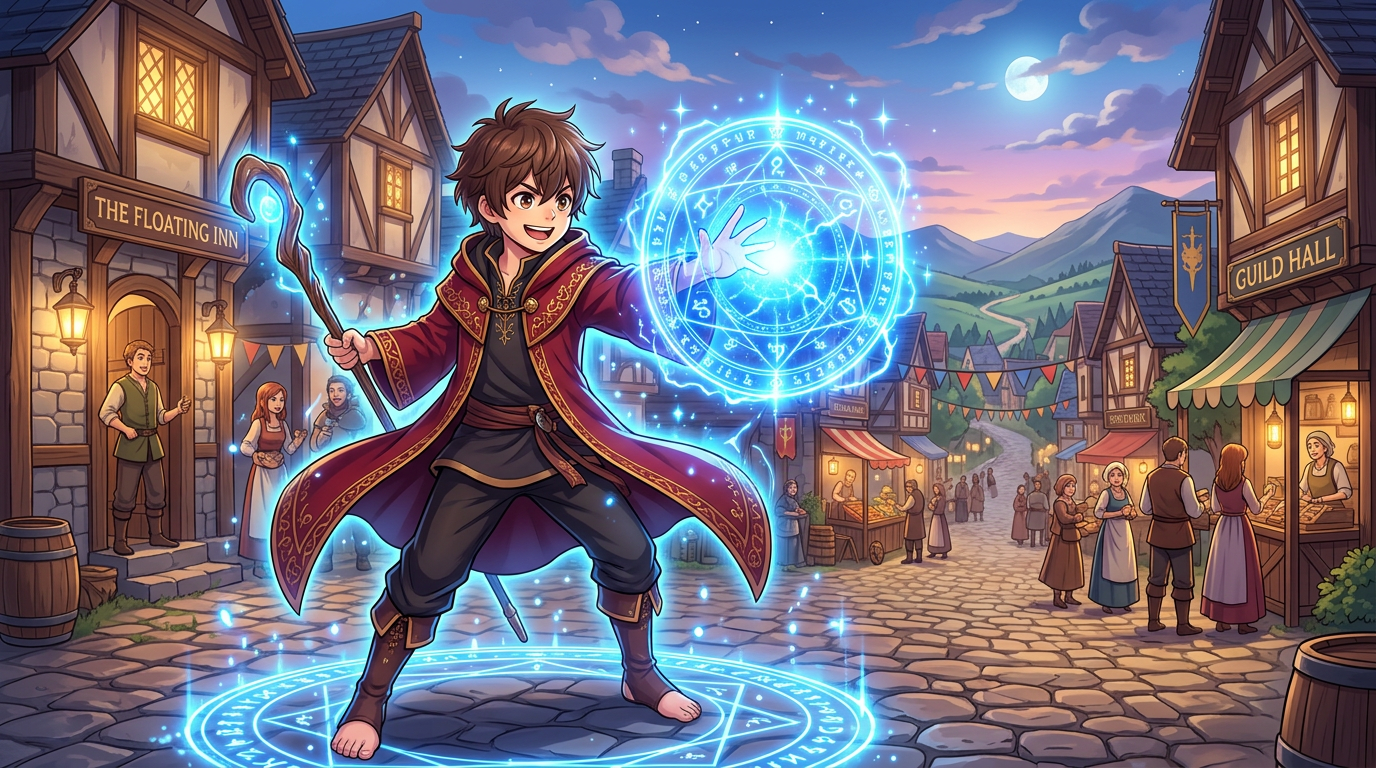
Anime · 12 questions
Mushoku Tensei: Jobless Reincarnation Quiz
How well do you know Rudeus, his second life and the world of Mushoku Tensei?
Anime · 12 questions
Anime Legends Quiz: 12 Questions Only Real Fans Pass
Twelve questions across four decades of anime, from 1980s film landmarks to modern streaming record breakers.
Comments
Share your score, argue with a question or add a fact we missed. Comments are checked before they appear, and links are removed automatically.
- No comments yet. Be the first.