

Longest Living Animals: Records, Facts & Myths
Animals · 12 min read · 10/22/2026
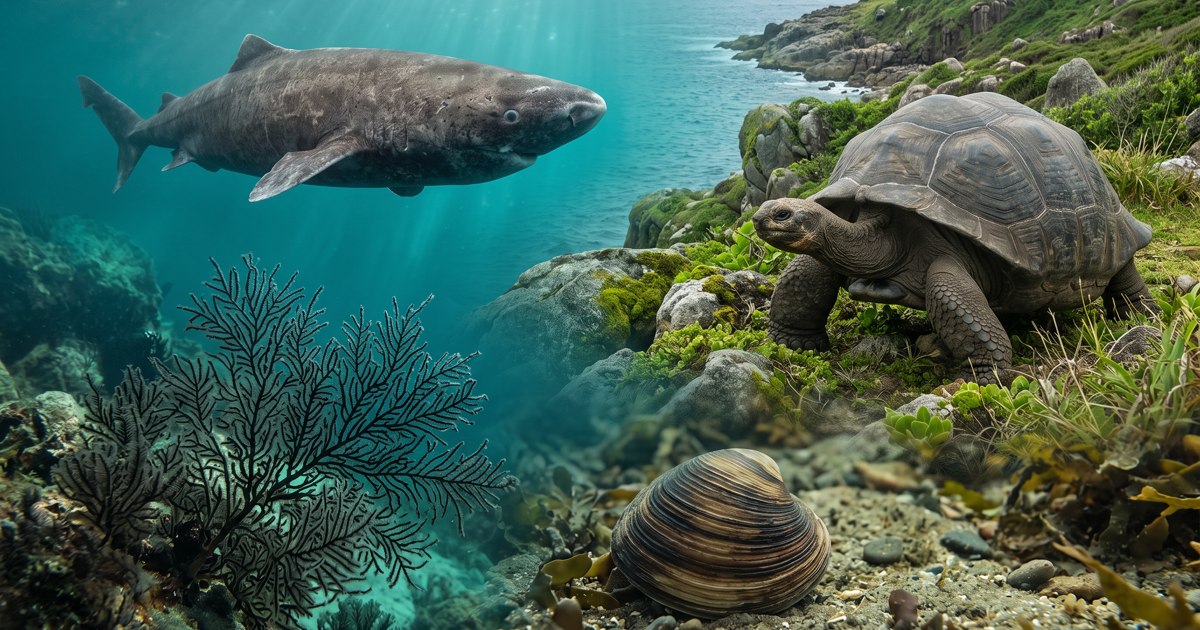
AI-generated cover illustration. Sources and study notes below.
What animal lives the longest? It depends on what you count. Some deep-sea sponges have estimated ages of thousands of years, and black coral colonies have been dated to more than 4,000 years. Among individual, non-colonial animals with shell-based age records, an ocean quahog named Ming reached 507 years. Greenland sharks are the longest-lived vertebrates supported by current age-estimation research. The so-called immortal jellyfish belongs in a different category: it can reverse its life cycle, but no individual has been proved to live forever.
Those distinctions matter. A viral chart that lists an infinity symbol beside a jellyfish and a precise number beside every other animal makes very different kinds of evidence look interchangeable. This Trivia Quiz World guide separates counted ages, estimated ages, colony records and biological possibilities. The figures below describe exceptional records or research estimates—not how long every member of a species normally lives.
Longest living animals: the evidence at a glance
| Animal | Reported age or ability | What the evidence means |
|---|---|---|
| Glass sponge (Monorhaphis chuni) | 11,000 ± 3,000 years | Model-based estimate from a giant skeletal spicule; substantial uncertainty |
| Black coral (Leiopathes) | 4,265 years | Radiocarbon estimate for a colony's skeleton, not one polyp |
| Ocean quahog: Ming | 507 years | Revised shell-increment age of an individual collected in 2006 |
| Greenland shark | 392 ± 120 years | Estimate for the largest shark in a 2016 study; approximately 272–512 years |
| Bowhead whale | Potentially over 200 years | Biochemical age estimates; not a birth-documented 200-year lifespan |
| Rougheye rockfish complex | 205 years | Otolith-based record reported before a later species split |
| Giant tortoise: Jonathan | Born approximately 1832 | Estimated birth year; roughly 194 in 2026, not known from birth |
| Red sea urchin | Over 100 years | Supported by bomb-pulse radiocarbon research; 200-year claims need qualification |
| Human: Jeanne Calment | 122 years, 164 days | Fully authenticated human lifespan record |
| Immortal jellyfish | Life-cycle reversal | A developmental ability, not a measured infinite lifespan |
Why isn't this table strictly ranked? The sponge estimate spans thousands of years, the coral is a colony, and the shark has a wide probability interval. Ordering all three as if their ages were exact birthdays would hide the most important information. The human record is included as a familiar comparison: humans are animals too.
1. Glass sponges: a possible millennia-long life
A glass sponge is an animal, not a plant or a rock. Monorhaphis chuni produces an exceptionally long glass-like skeletal structure called a basal spicule. Researchers studied the chemical record in one of these spicules and used reconstructed temperature changes to estimate an age of 11,000 ± 3,000 years. The study record linked below describes the method and its uncertainty.
That is an astonishing result, but the careful wording is 'estimated', not 'verified to have lived exactly 11,000 years'. Nobody watched the sponge grow throughout that period. The age depends on the reconstruction and assumptions used to connect the skeletal record to time. A headline saying '10,000+ years' loses the uncertainty and may imply the same lifespan applies to all glass sponges. It does not.
2. Black coral: a colony older than civilizations
In a 2009 PNAS study, researchers used radiocarbon dating to estimate the age of a deep-water Leiopathes black coral specimen at 4,265 years. That makes the colony a remarkable archive of marine history. NOAA explains that deep-sea corals can live for hundreds or thousands of years and that their skeletons help researchers reconstruct past conditions.
The word 'colony' is essential. A branching coral contains many polyps: small animals sharing a skeletal structure. Dating an old part of that skeleton does not mean a single polyp has remained alive for four millennia. Black coral also gets its name from its dark skeleton, not necessarily the color of its living tissues. Treat its record as colonial longevity rather than directly comparing one polyp with one shark.
3. Ming the clam: the 507-year-old ocean quahog
An ocean quahog, Arctica islandica, collected near Iceland in 2006 became famous as Ming. Guinness World Records records its revised age as 507 years. Earlier work had put the age at roughly 405–410 years; improved examination of the shell growth record produced the older figure. The animal's shell, rather than a centuries-long written diary, supplied the evidence.
Ming is especially useful in animal trivia because it was an individual, non-colonial animal. Unlike a coral colony, it was not thousands of polyps sharing a long-lived structure. But its record still should not become 'all ocean quahogs live 507 years'. A maximum observed age is different from a species average, and Ming is not alive today. 'Oldest animal ever recorded' and 'oldest animal currently living' are different questions.
4. Greenland sharks: the longest-lived vertebrates
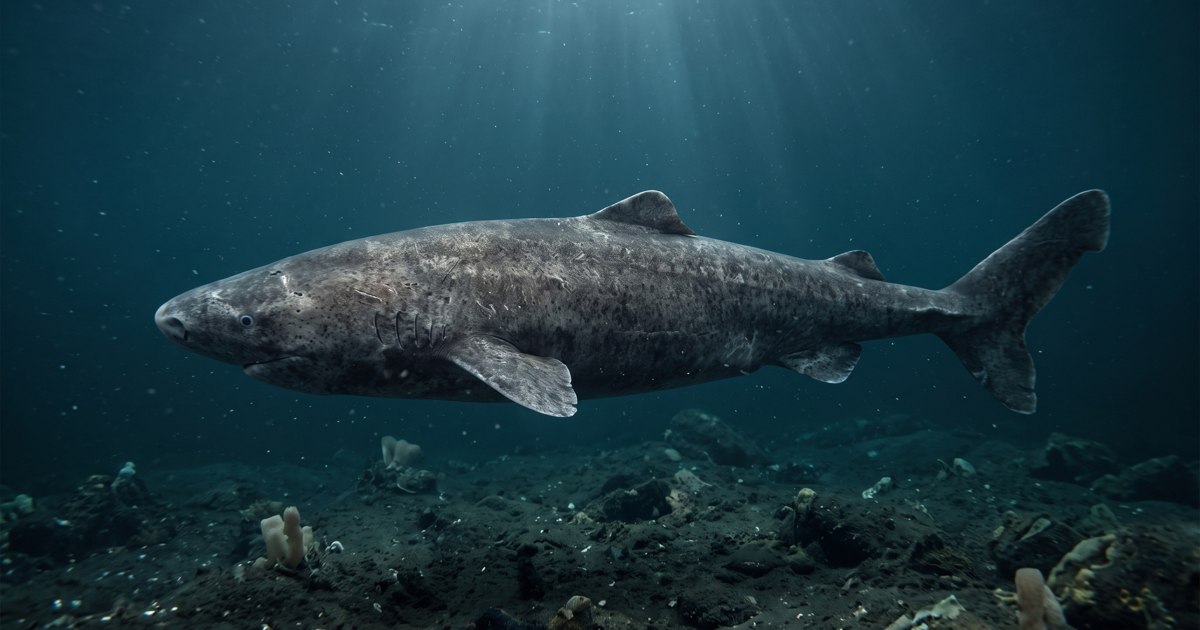
The Greenland shark, Somniosus microcephalus, is a cold-water fish with an extraordinary lifespan. A 2016 study in Science examined eye-lens material from 28 female sharks. The largest sampled animal measured 5.02 meters and had an estimated age of 392 ± 120 years. The researchers reported this as a midpoint with a 95.4% probability interval, not as a precisely known birthday.
In other words, the widely shared '400-year-old shark' is shorthand for an estimate with a large range—approximately 272 to 512 years for that specimen. Saying it was definitely 512 years old selects the oldest end of the range and misrepresents the result. Saying 392 without the uncertainty also suggests more precision than the method provides.
The study used radiocarbon in eye-lens nuclei, material laid down early in life. This helps answer a question that body size alone cannot resolve. A very large animal is not automatically a very old one; growth varies among species and environments. Greenland sharks offer a powerful lesson in both biology and scientific measurement: the record is impressive even when its limits are stated honestly.
5. Bowhead whales: century-spanning mammals
Bowhead whales are among the longest-lived mammals. Research using changes in amino acids in eye-lens material supports exceptional longevity, with some estimates exceeding 200 years. These biochemical estimates become less certain at older ages, so a chart showing '211 years' as a clean, universally verified record needs qualification.
A different line of evidence comes from an old weapon fragment recovered from a harvested bowhead. Dating the object independently indicated that the whale was at least about 115 years old. The Polar Biology study below discusses that evidence. A recovered artifact supplies a minimum-age clue; it does not give the whale's birth date. Together, the methods explain why bowheads are famous for longevity without requiring us to pretend every age estimate is exact.
6. Rougheye rockfish: 205 years in an ear stone
Fish have otoliths—small mineral structures associated with the inner ear—that can preserve growth increments. An Alaska Department of Fish and Game report described a rougheye rockfish aged at 205 years using a sectioned otolith. That is the origin of one of the most striking fish-age figures in popular animal lists.
There is also a taxonomy caveat. The historically broad rougheye rockfish complex was later recognized as two species, Sebastes aleutianus and Sebastes melanostictus. A record reported under the older classification should not automatically be assigned to both modern species. This is a useful reminder that scientific names and identification methods can change while an old number continues circulating online.
7. Giant tortoises: Jonathan's estimated age
Jonathan, the Seychelles giant tortoise on St Helena, is a celebrated land-animal longevity record holder. Guinness lists his birth year as approximately 1832. That estimate comes from his being described as fully mature when brought to St Helena in 1882, implying he was already at least about 50 years old.
Using that estimated year makes him roughly 194 in 2026. It does not establish an exact birthday or an age documented continuously since hatching. An article can responsibly call him a remarkable example of giant-tortoise longevity while explaining where the calculation comes from. For a trivia question, the best memorable fact is his estimated birth year and the maturity evidence—not an age that silently becomes outdated each January.
8. Red sea urchins: century-old grazers
Red sea urchins are echinoderms, relatives of sea stars rather than fish. A Fisheries Bulletin study used bomb-pulse radiocarbon to confirm that they can live over 100 years. That technique draws on the distinctive radiocarbon signal left by twentieth-century nuclear weapons testing and checks whether an age model fits real chronological evidence.
You will often see a 200-year lifespan attached to red sea urchins. The primary paper cited here supports the more conservative 'over 100 years'. A two-century figure should be labeled according to the separate estimate supporting it, not passed off as the exact age of a documented individual. The century-scale finding is already extraordinary; inflating it does not make the science more interesting.
9. Immortal jellyfish: can an animal really live forever?
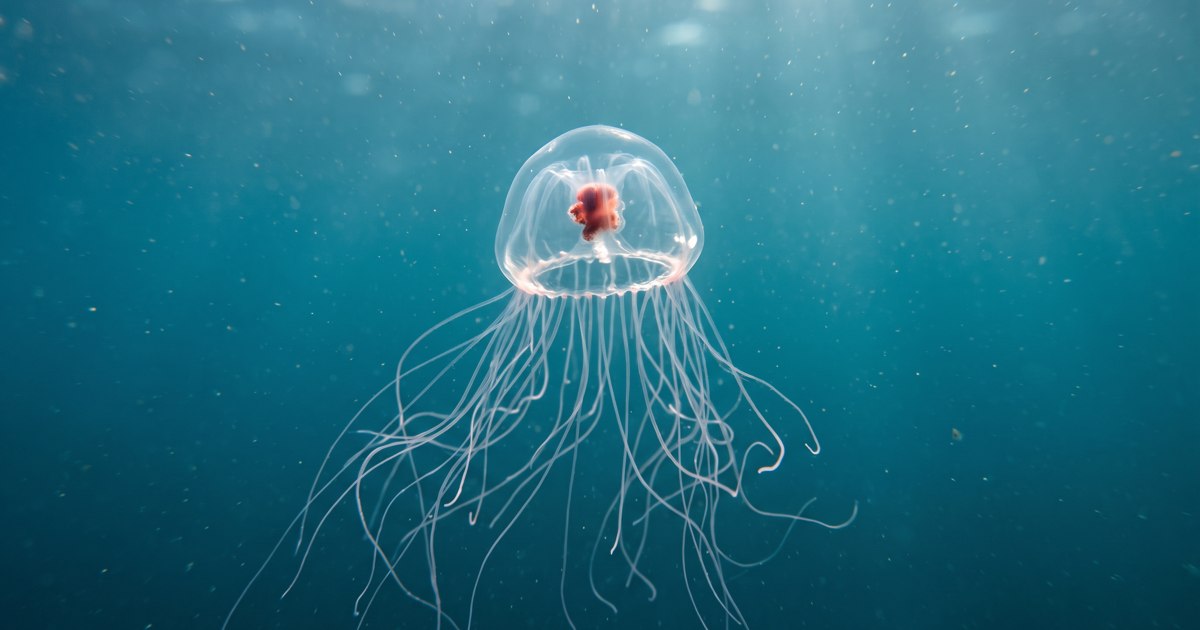
Turritopsis dohrnii is nicknamed the immortal jellyfish because it can reverse development from its swimming medusa stage to an earlier polyp stage under certain conditions. Studies of that process investigate how its cells and developmental programs change. This is a real biological capability, not merely an internet invention.
What is misleading is the leap from 'can reverse its life cycle' to 'cannot die'. Reversal does not prevent predation, disease or other lethal events. Nor does it provide a verified record of one individual surviving indefinitely in the wild. A life cycle that can restart is different from a measured lifespan of infinity. Put the jellyfish in a fascinating-adaptations category, not at the top of an age leaderboard.
10. Humans and koi: records versus repeated stories
The longest fully authenticated human lifespan belongs to Jeanne Calment: 122 years and 164 days. Guinness records her birth on February 21, 1875, and death on August 4, 1997. Unlike many marine-animal ages, this is a record established through human documentation rather than radiocarbon, growth increments or a temperature model.
Koi also appear in longevity charts, sometimes alongside the much-repeated story of Hanako supposedly reaching 226 years. This guide does not use that story as an authenticated animal record, or describe a 70–80-year koi age as a verified species maximum without matching evidence. Repetition is not verification. If a number cannot be connected to a reliable method and source, it should not outrank better-supported records.
How scientists work out an animal's age
- Documented dates: records can establish a lifespan when birth and death are reliably known, as with Calment.
- Growth increments: clam shells and fish otoliths can preserve successive layers, but researchers must validate how those increments relate to time.
- Radiocarbon dating: carbon isotope measurements help date biological material or test age models, with uncertainty that must remain attached to the result.
- Biochemical clocks: changes in eye-lens compounds can estimate age, but calibration and confidence at extreme ages matter.
- Historical clues and models: maturity at arrival, dated artifacts and reconstructed environmental records can support estimates or minimum ages, not necessarily exact birthdays.
Why so many longevity records come from the sea
The table contains many marine animals, including species from cold or deep habitats. Slow growth and stable environments are useful clues to their life histories, but there is no universal rule that cold water automatically creates a centuries-long lifespan. A species' survival, reproduction and physiology all matter. Long-lived animals also cannot be understood simply by comparing body size: a clam can outlive a whale.
These records highlight another practical distinction. A slow-growing animal may take a long time to replace losses in a population. Finding an exceptionally old specimen tells us about biological possibility; it does not tell us that the species is safe from fishing, habitat damage or environmental change. Longevity is not invulnerability.
Longest living animals: quick answers
What is the longest living animal on Earth? Deep-sea sponge research gives some of the largest age estimates, while black coral colonies have radiocarbon ages exceeding 4,000 years. For a famous individual, non-colonial animal with a shell-age record, Ming the ocean quahog reached 507 years. State which category you mean before naming a winner.
What animal lives the longest on land? Giant tortoises are standout land-animal longevity examples. Jonathan's estimated birth year of around 1832 puts him at roughly 194 in 2026; the estimate is based on maturity at his arrival on St Helena, not a recorded hatching date.
Can a Greenland shark live 500 years? The 2016 study's interval for its oldest estimated specimen extended to approximately 512 years. That means the estimate allows such an age; it does not prove that shark was exactly 500 or 512 years old.
Is the immortal jellyfish the oldest animal? Not by a verified age record. Its claim to fame is life-cycle reversal, not an individual known to have survived forever. It can still die.
Are these maximum lifespans the same as average lifespans? No. An exceptional specimen, an estimated upper range and a typical lifespan answer different questions. Keeping them separate turns a surprising list into reliable animal trivia.
Animal longevity: 10 record-and-evidence questions
Question 1 of 10
Which animal was the individual nicknamed Ming?
Sources & further reading
Sources checked for this article’s publication on October 22, 2026. Study figures retain their original publication dates.
- Science (2016): Eye lens radiocarbon reveals centuries of longevity in the Greenland shark
- University of Copenhagen: Greenland shark study abstract and age interval
- Guinness World Records: Ming, the oldest mollusc
- PNAS (2009): Extreme longevity in proteinaceous deep-sea corals
- NOAA Ocean Exploration: How long can corals live?
- University of Lausanne study record: Monorhaphis chuni spicule age estimate
- Canadian Journal of Zoology: Age estimation of bowhead whales
- Polar Biology: Weapon fragment evidence for bowhead longevity
- Alaska Fishery Research Bulletin: Radiocarbon validation of rockfish ages
- NOAA Fisheries Bulletin: The rougheye rockfish species complex
- NOAA Fisheries Bulletin: Red sea urchins can live over 100 years
- Guinness World Records: Jonathan, the oldest tortoise
- Guinness World Records: Oldest person ever
- Peer-reviewed research (2021): Life-cycle reversal in Turritopsis dohrnii
Shop this topic on Amazon
As an Amazon Associate we earn from qualifying purchases.
Test yourself on this topic

Animals · 12 questions
Animal Oddities Quiz: 12 Facts That Sound Made Up
Twelve questions about record breakers, strange defences and animals whose reputations are entirely wrong.
Animals · 12 questions
Ocean Giants Quiz: The Biggest Animals in the Sea
Blue whales, whale sharks, giant squid and more. Twelve questions on the ocean's largest residents.
Comments
Share your score, argue with a question or add a fact we missed. Comments are checked before they appear, and links are removed automatically.
- No comments yet. Be the first.