

How to Identify Every Kanye Album by Sound & Era
Music · 6 min read · 10/31/2026
Few discographies in modern music history are as neatly compartmentalized into distinct sonic and visual eras as that of Kanye West. From the pitched-up soul chops of his mid-2000s breakthrough to the sparse, industrial distortion of his 2010s output, each project serves as a time capsule of a specific aesthetic philosophy.
For music trivia buffs, identifying which song, visual cue, or production quirk belongs to which era is an art form. Whether you are analyzing a brief audio snippet or breaking down the artistic motifs of a jacket cover, here is the definitive breakdown to help you decode every single chapter of this catalog.
The Sonic Signatures of the Dropout Trilogy
To identify music from the initial phase of West's solo career, listen closely to the rhythm section and the vocal samples. Spanning from 2004 to 2007, the early trilogy shares a common mascot—the collegiate Dropout Bear—but each record possesses a sharply defined sonic thumbprint.
- The College Dropout (2004): Defined by "chipmunk soul"—classic soul records sped up to high pitches so vocal hooks could double as rhythmic loops. If you hear sped-up Marvin Gaye, Chaka Khan, or Aretha Franklin samples paired with crisp Roland MPC percussion and witty, observational verses about working minimum wage, you are squarely in 2004.
- Late Registration (2005): West brought in film composer Jon Brion, known for scoring *Eternal Sunshine of the Spotless Mind*, to co-produce. The telltale clue here is classical instrumentation. String quartets, harpsichords, bells, and brass arrangements weave around samples of Shirley Bassey and Curtis Mayfield. It sounds grand, orchestral, and decidedly warm.
- Graduation (2007): To identify tracks from this era, listen for arena-ready synthesizers inspired by stadium rock and European electronic dance music. If the sample comes from Daft Punk, Steely Dan, or Can, and the drums lean heavily into four-on-the-floor electro-pop textures, it belongs to the shutter-shades and Takashi Murakami visual era.
"I made up my mind to make music that could play in stadiums. That changed the entire way I wrote and produced."
The 808s Paradigm Shift: Synths, Auto-Tune, and KAWS
If you hear a sparse, cold, electronic pulse driven almost entirely by the hollow thump of a vintage drum machine, you have landed in the winter of 2008. *808s & Heartbreak* abandoned conventional rap verse structures almost entirely, pioneering a melancholic soundscape that transformed hip-hop and R&B for the next decade.
Key identifying traits for this period include heavy Antares Auto-Tune used not as a corrective tool, but as an emotional instrument. The instrumentation relies overwhelmingly on the Roland TR-808 rhythm machine, complemented by cold synthesizer pads, minimal piano motifs, and tribal taiko drums.
Visually, this era is signified by austere grey suits, an embroidered red heart pin, and the iconic torn heart illustration created by contemporary artist KAWS. Lyrically, themes shift from ambition and humor to grief, alienation, and romantic disillusionment.
Maximalist Perfection: My Beautiful Dark Twisted Fantasy
When a track sounds as though thirty musicians, five producers, and a full choir labored over every individual bar, it belongs to the 2010 *My Beautiful Dark Twisted Fantasy* era. Recorded during a self-imposed exile in Oahu, Hawaii, this record represents hip-hop maximalism at its absolute peak.
- Multi-Layered Horns and Pianos: Tracks often build from simple piano chords (such as the solitary repeated high key notes on "Runaway") into overwhelming symphonies featuring live horns, electric guitars, and distortion pedals.
- High-Profile Cameos: Listen for unexpected vocal blends. An era track might combine folk singer Justin Vernon (Bon Iver), Elton John, Rihanna, and Rick Ross in a single composition.
- Visual Clues: Bold crimson framing surrounding surrealist oil paintings by contemporary artist George Condo. The tailoring of this era featured tailored red tuxedos and heavy Egyptian-inspired gold chains.
- Classic Rock Samples: Rather than soul singles, production in this era heavily excavated 1970s progressive rock, including King Crimson and Mike Oldfield.
Industrial Minimalism: The Harsh World of Yeezus
If the opening second of a track blasts your speakers with abrasive, distorted synth screeches, there is no guessing required: it is 2013's *Yeezus*. Built as a direct reaction against the lush orchestration of its predecessor, this era stripped away every melodic comfort in favor of aggressive industrial noise.
West enlisted French electronic duo Daft Punk, young producer Arca, and legendary minimalist Rick Rubin to strip tracks down to their bare essentials. Identifying features include acid house basslines, distorted dancehall riddims, Chicago drill percussion, and samples that abruptly cut in and out without transitions.
Visually, the era rejected artwork entirely. The physical CD was sold in an unadorned, clear jewel case sealed only by a piece of red gaffer tape, accompanied by stark typography and tour merchandise heavily influenced by 1980s heavy metal aesthetics.
Fragmented Masterpieces: The Life of Pablo to Donda
From 2016 onward, the release process shifted toward living, breathing software updates, where albums were altered and remixed even after appearing on streaming platforms.
- The Life of Pablo (2016): Characterized by a juxtaposition of triumphant Southern gospel choirs and dark, chaotic Metro Boomin trap beats. The visual motif is an aggressive collage of orange backgrounds and repeated text designed by Peter De Potter.
- The Wyoming Sessions (2018): Consisting of *ye* and collaborative projects like *Kids See Ghosts*, tracks from this summer are strictly concise, recorded under a disciplined seven-track framework. Production blends ambient field recordings with classic soul loops and psychedelic rock.
- Jesus Is King (2019): Instantly recognizable by the absence of explicit language and the presence of the Sunday Service Choir, Hammond B3 organs, and brass horns, all packaged under the imagery of a royal blue vinyl disc.
- Donda (2021): Dominated by dark, echoing bass drops, church organs, and empty space, completely stripped of percussion in multiple instances. Visually represented by a pure black void, reflecting themes of grief and spiritual warfare.
"Art is about knowing when to stop, but sometimes it is about letting the public watch you paint."
Visual Artists Behind the Iconic Covers
Beyond production, one of the easiest ways to identify each era is knowing the visual artists West commissioned to establish his aesthetic identity:
- Takashi Murakami: Handled the vibrant, anime-inspired aesthetic of *Graduation* (2007) and the watercolor spirit landscapes of *Kids See Ghosts* (2018).
- George Condo: Created five interchangeable, provocative oil paintings depicting ballerinas, crowns, and distorted faces for *My Beautiful Dark Twisted Fantasy* (2010).
- Peter De Potter: The Belgian artist who pioneered internet Tumblr typography, responsible for the overlapping, repeated sans-serif design of *The Life of Pablo* (2016).
- KAWS (Brian Donnelly): Created the deluxe vinyl and single artwork for *808s & Heartbreak* (2008), rendering his signature 'X' hands and clean-lined figures.
Frequently Asked Questions About Identifying Kanye Albums
How can you tell The College Dropout from Late Registration?
Listen to the instrumentation. While *The College Dropout* relies almost exclusively on MPC drum beats and sped-up vinyl soul samples, *Late Registration* incorporates live orchestral instruments like cellos, harpsichords, and French horns arranged by Jon Brion.
Which Kanye West album has no cover art?
*Yeezus* (2013) features no traditional front artwork. The physical release was simply a transparent jewel case with a red sticker sealing the right edge, while digital releases often display an image of that plain cassette or CD case.
What album introduced the vocoder and Auto-Tune sound to his discography?
*808s & Heartbreak* (2008) was the first project to feature Auto-Tune on nearly every vocal track. Prior albums used vocoders sparingly as studio accents, but *808s* turned the vocal pitch processor into a central stylistic voice.
Shop this topic on Amazon
As an Amazon Associate we earn from qualifying purchases.
Test yourself on this topic
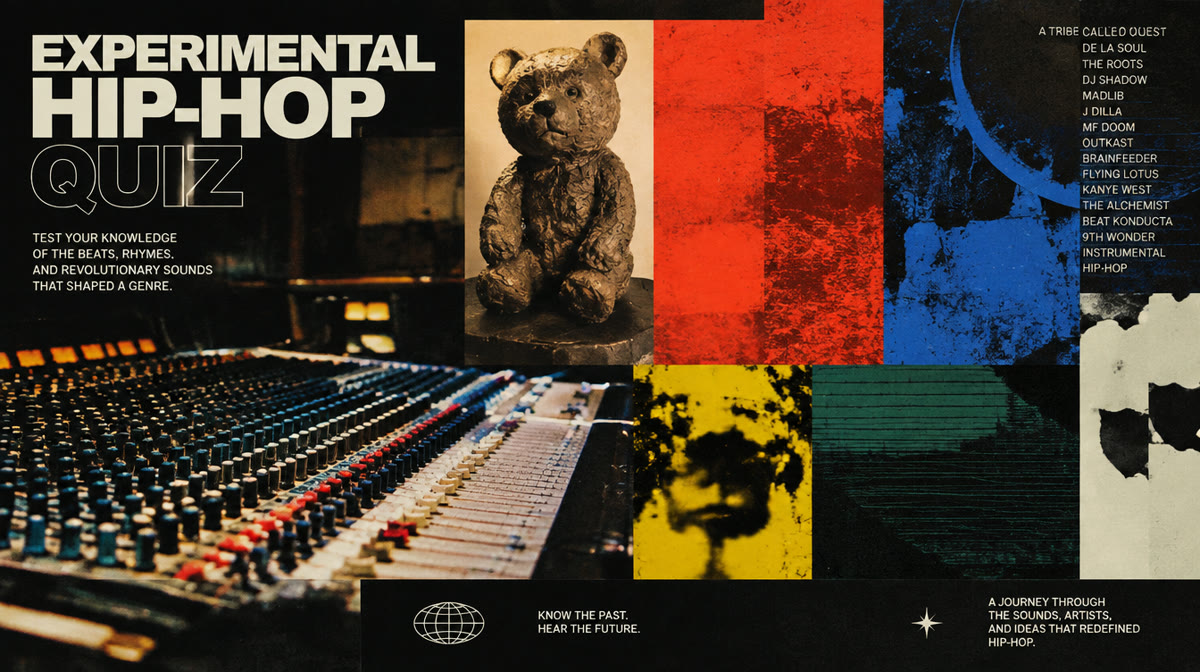
Music · 12 questions
Kanye West Trivia Quiz: Albums, Songs & Production
Kanye West trivia questions with answers: his albums from The College Dropout onward, famous samples, collaborations and production work.
Music · 12 questions
Pop Music Decades Quiz: 12 Chart-Topping Questions
From vinyl-era anthems to streaming-era records, twelve questions that test how much chart history you absorbed.

Pop Culture · 12 questions
2010s Internet Culture Quiz: Memes, Apps and Viral Moments
The decade that gave us viral dances, six-second videos and a dress nobody could agree on. Twelve questions.
Comments
Share your score, argue with a question or add a fact we missed. Comments are checked before they appear, and links are removed automatically.
- No comments yet. Be the first.