

Famous Cities Past and Present: 12 History Facts
World Geography · 5 min read · 11/17/2026
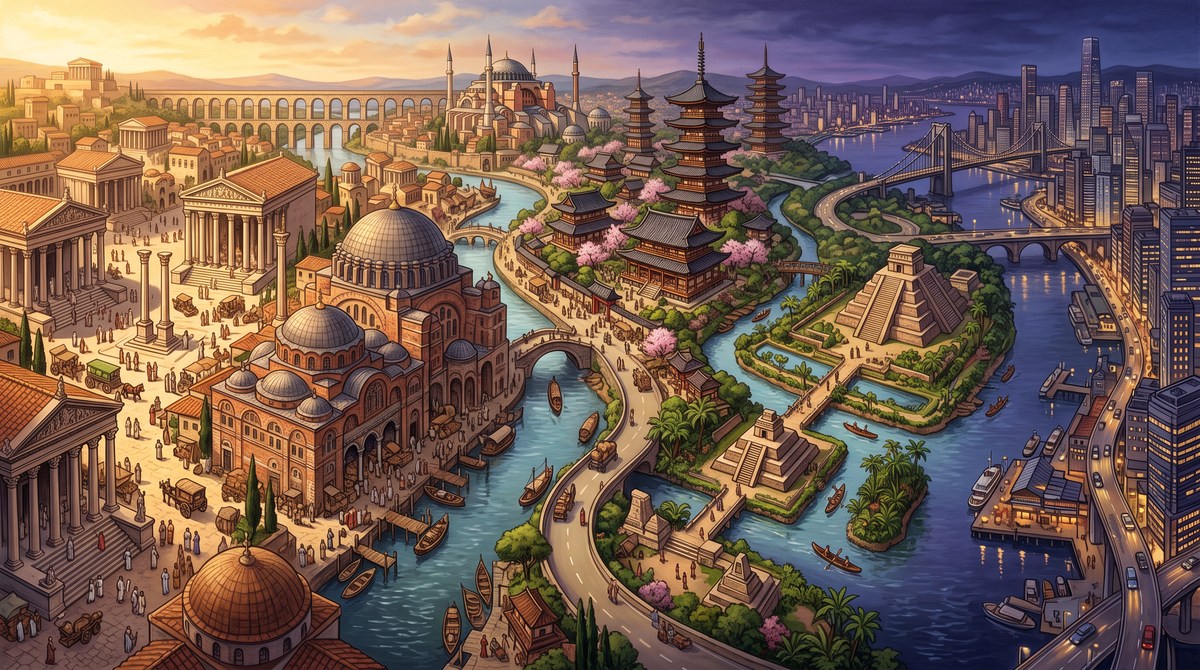
Original editorial illustration connecting historic city landscapes with their modern successors.
Famous cities are not museums with a single date attached. Streets are rebuilt, names change and older structures become part of daily life. This city history trivia guide compares four places where the past remains visible: Rome, Kyoto, Istanbul and Mexico City. It also separates legend from evidence, beginning with Rome’s famous wolf-raised founders.
Rome: a legendary date and a very real monumental landscape
UNESCO repeats the tradition that Romulus and Remus founded Rome in 753 BCE, but the wording matters: this is the city’s founding legend, not a documented construction date. Rome later became the center of the Roman Republic and then the Roman Empire. Its World Heritage landscape includes the Forums, Pantheon, Trajan’s Column and the mausoleums of Augustus and Hadrian alongside later papal buildings.
That layering explains why Rome cannot be reduced to the Colosseum alone. Ancient monuments, medieval changes and religious architecture occupy the same urban fabric. A visitor is not looking at one perfectly preserved century; they are walking through many periods that continually reused the city.
Kyoto: designed in 794 as an imperial capital
Kyoto was built in 794 on a model influenced by ancient Chinese capitals. It served as Japan’s imperial capital from its foundation until the middle of the 19th century. UNESCO highlights more than a thousand years of cultural development, particularly wooden religious architecture and garden design. Its World Heritage listing also includes monuments in nearby Uji and Otsu, so the official site is broader than Kyoto’s city center.
Istanbul: Byzantion, Constantinople and an Ottoman capital
Istanbul’s strategic position links the Balkans and Anatolia as well as the Black Sea and Mediterranean routes. Constantine I raised the older city of Byzantion to imperial-capital status in 330 CE. It became known as Constantinople and remained the Byzantine capital until 1453, when it fell to the Ottomans. It then served as an Ottoman capital until 1922.
The architecture carries pieces of that history. UNESCO names the Hippodrome of Constantine, the sixth-century Hagia Sophia and the 16th-century Süleymaniye Mosque among its major monuments. Calling the whole story a simple name swap misses the political and cultural continuity that survived each change of rule.
Mexico City: built over Tenochtitlan
The Spanish built Mexico City in the 16th century on the ruins of Tenochtitlan, the Mexica capital. UNESCO’s description identifies the remains of five Aztec temples within the historic center and places the city’s later cathedral and public buildings in the same World Heritage landscape. The modern metropolis did not merely appear beside the old capital; it rose directly over it.
About 28 kilometers south of the center, Xochimilco preserves canals and artificial agricultural islands known as chinampas. These features record another side of the region’s urban history: communities engineered productive land within a challenging lake environment. The famous colorful boats are only the most visible part of a much older cultural landscape.
| City | Earlier role | Detail that survives |
|---|---|---|
| Rome | Center of the Roman Republic and Empire | Forums, the Pantheon, columns and imperial mausoleums. |
| Kyoto | Japan’s imperial capital from 794 to the mid-19th century | Wooden religious architecture and influential garden design. |
| Istanbul | Byzantine and later Ottoman imperial capital | The Hippodrome, Hagia Sophia and Süleymaniye Mosque. |
| Mexico City | Built over Tenochtitlan in the 16th century | Temple remains, later civic buildings and nearby Xochimilco’s canals. |
Past and present are not separate exhibits
These cities continue to house residents, traffic, businesses and public services. Preservation therefore involves more than protecting a postcard view. A temple can face pollution, a wooden district can face fire, and an ancient water system can sit inside a growing metropolis. The best city trivia notices that tension instead of treating historic centers as places where time stopped.
Ready for another round? Test your recall in the World Capitals Quiz or identify the monuments in our World Landmarks Quiz.
Famous cities past and present: 10 questions
Question 1 of 10
Which date belongs to Rome’s founding legend?
Sources & further reading
Sources checked for this article’s publication on November 17, 2026. Study figures retain their original publication dates.
Shop this topic on Amazon
As an Amazon Associate we earn from qualifying purchases.
Test yourself on this topic
Global Knowledge · 15 questions
World Capitals Quiz: 15 Capital Cities
Take our world capitals quiz: 15 capital cities people get wrong, from Canberra and Ankara to Abuja and Astana, with the story behind each answer.
Global Knowledge · 12 questions
World Landmarks Quiz: Guess the Monument
Test your knowledge of the world's most iconic landmarks, from ancient wonders to modern marvels.
General Knowledge · 15 questions
World History Quiz: 15 Big Moments
A world history quiz on 15 turning points, from the first writing and the Roman Empire to the printing press, the moon landing and the internet.
Comments
Share your score, argue with a question or add a fact we missed. Comments are checked before they appear, and links are removed automatically.
- No comments yet. Be the first.