

40 Capybara Facts: Habitat, Behavior & Family Life
Animals · 5 min read · 10/8/2026
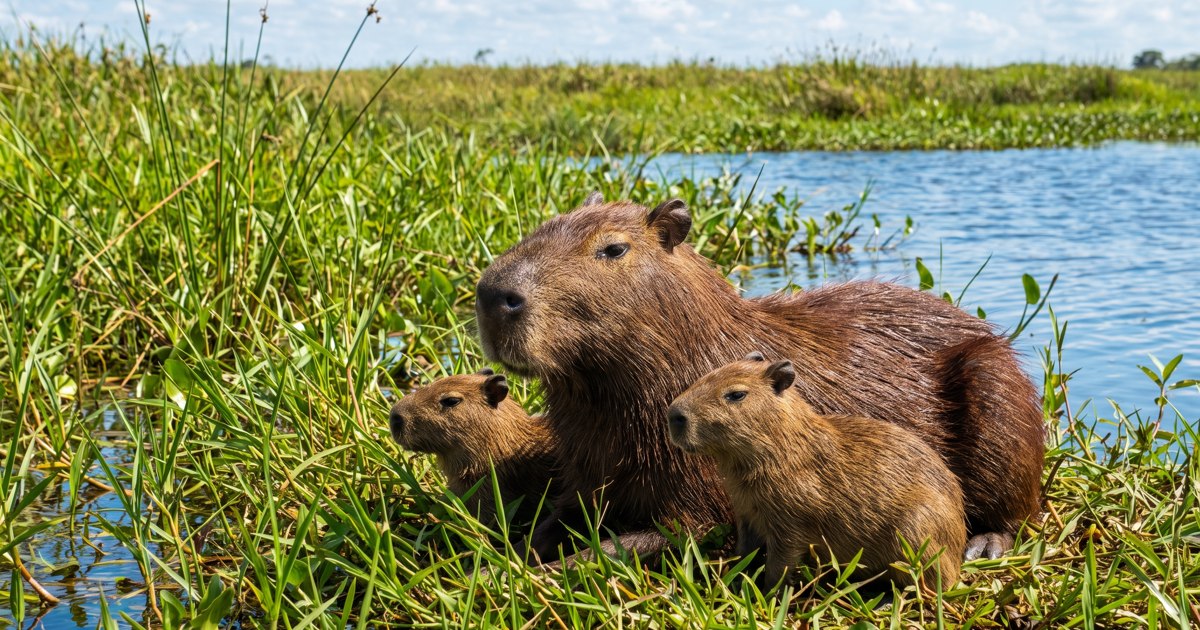
AI-generated cover illustration. Sources and study notes below.
Capybaras are the world’s largest living rodents. The common capybara, Hydrochoerus hydrochaeris, is a South American, semi-aquatic herbivore related to guinea pigs. Its internet reputation for relaxed friendships is entertaining, but its real story is about grazing, water and group survival. These 40 facts separate useful biology from the idea that a wild animal is a cuddly pet.
Size, shape and swimming: facts 1–10
Their body is built for moving between grassy banks and water. The features that make them look unusual on land become practical when only the top of the head breaks the surface.
- 1. Capybaras are the largest rodents alive today; they are not the largest rodents ever to have existed.
- 2. Adults can weigh more than 100 pounds, though size varies with sex and individual.
- 3. Their bodies are barrel-shaped, with short legs and coarse brownish hair.
- 4. A capybara has no conspicuous external tail, unlike a beaver or many smaller rodents.
- 5. Eyes sit high on the head, helping an animal look around while mostly submerged.
- 6. The ears and nostrils are also positioned high on the head, useful for a life close to water.
- 7. Partly webbed feet help with swimming rather than turning its legs into flippers.
- 8. There are four toes on each front foot and three on each hind foot.
- 9. Capybaras can stay submerged for about five minutes; they breathe air, not through gills.
- 10. Their front incisor teeth grow continuously and are worn down through feeding.
Habitat and food: facts 11–20
“Capybara” can describe two closely related species. The common capybara’s broad South American range should not be confused with the lesser capybara’s range extending into Panama.
- 11. The common capybara is native to much of South America east of the Andes.
- 12. The lesser capybara, Hydrochoerus isthmius, is a separate, smaller species.
- 13. Lesser capybaras occur in northwestern South America and Panama; that does not put every common capybara population in Central America.
- 14. Rivers, marshes, ponds and seasonally flooded habitats can support capybaras.
- 15. Nearby grazing land is important: water alone is not an adequate habitat.
- 16. They are herbivores, feeding heavily on grasses and aquatic plants.
- 17. Their diet can change seasonally as available vegetation changes.
- 18. Capybaras eat some of their own droppings, recovering nutrients from plant material.
- 19. Water and mud help them cool down in hot conditions.
- 20. Activity often concentrates around cooler parts of the day, but local conditions affect the schedule.
Family life and communication: facts 21–30
Their social habits are not just cute. Group living affects breeding, defence and access to resources. A video of one capybara tolerating another species cannot show all of that complexity.
- 21. Capybaras are social rather than normally solitary animals.
- 22. A typical group can include around ten individuals, with substantial variation.
- 23. Much larger gatherings can form around remaining water during the dry season.
- 24. Groups may contain a dominant male, females, young and subordinate males.
- 25. A male has a prominent scent gland on the snout known as a morillo.
- 26. Scent marking conveys information within their social world.
- 27. Capybaras communicate with several sounds, including barks and whistles.
- 28. An alarm bark can warn nearby group members of danger.
- 29. Young are born relatively well developed, with fur and open eyes.
- 30. Females may nurse young other than their own, an example of shared care.
Wildlife, conservation and the internet: facts 31–40
A widespread species can still face local pressure. The common capybara is listed as Least Concern by the IUCN; that label is not a claim that every wetland or local group is safe.
- 31. A litter commonly contains around four young, though litter size varies.
- 32. Young begin sampling vegetation early while still relying on milk.
- 33. Jaguars are among the predators of capybaras.
- 34. Large reptiles, including anacondas and caimans, can also prey on capybaras.
- 35. Water provides a refuge from some dangers, not protection from every predator.
- 36. Capybaras are part of wetland food webs as both grazers and prey.
- 37. Birds sometimes perch on capybaras; tolerance of them does not mean universal friendship with all animals.
- 38. People hunt capybaras for meat and hides in parts of their range.
- 39. Habitat loss and hunting can matter locally even when the species is globally Least Concern.
- 40. Captive care requires social companionship, suitable grazing, water and professional planning; internet popularity is not a pet-care qualification.
Why does everyone call capybaras friendly?
Their tendency to rest calmly near other animals makes memorable photos. It is better to describe the behaviour shown than invent a universal personality: an animal may be comfortable, cautious or defending itself depending on circumstances. Do not approach or feed wild capybaras. Supporting healthy wetland habitats does more for them than treating them as props for a selfie.
40 Capybara Facts quiz
Question 1 of 10
What is a capybara?
Sources & further reading
Editorial review: October 8, 2026. Calendar tools calculate dates automatically; study figures retain their original publication dates.
Shop this topic on Amazon
As an Amazon Associate we earn from qualifying purchases.
Comments
Share your score, argue with a question or add a fact we missed. Comments are checked before they appear, and links are removed automatically.
- No comments yet. Be the first.