

31 Axolotl Facts: Regeneration, Habitat & Biology
Animals · 5 min read · 10/8/2026
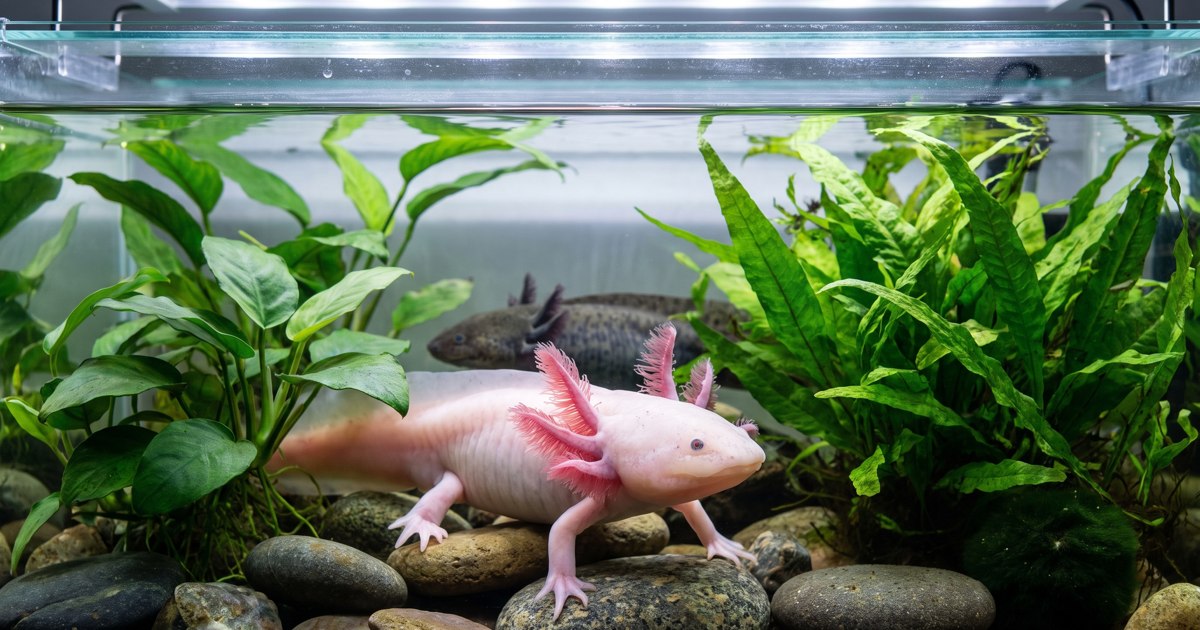
AI-generated cover illustration. Sources and study notes below.
An axolotl is an amphibian, not a fish. This Mexican salamander normally keeps its external gills into adulthood and can regenerate complex body parts. But regeneration is not immortality, and abundant captive animals do not mean the wild species is safe. These 31 facts explain both its fascinating biology and its conservation crisis.
A salamander with lasting juvenile features: facts 1–9
The phrase “never grows up” is a memorable shorthand for retained juvenile features, not a claim that axolotls never mature. They can reproduce while keeping their aquatic larval body form.
- 1. The axolotl’s scientific name is Ambystoma mexicanum.
- 2. It belongs to the salamanders, within the amphibian class.
- 3. Axolotls are members of the mole salamander genus Ambystoma.
- 4. They normally retain external gills as adults instead of completing the typical salamander transformation.
- 5. Retaining juvenile features into adulthood is called paedomorphosis; neoteny is the term often used for axolotls.
- 6. Those feathery structures extending from the head are gills, not decorative horns.
- 7. Axolotls can also exchange gases through their skin and have lungs.
- 8. They reach reproductive maturity despite retaining their larval-looking body.
- 9. Rare or experimentally induced metamorphosis is possible; trying to force it is not responsible pet care.
Regeneration and research: facts 10–19
Researchers study regeneration to understand cell behaviour, not because an axolotl’s ability can already be transferred to people. Injury experiments belong in regulated research, never in home demonstrations.
- 10. Axolotls can regrow lost limbs with bone, muscle, nerves and skin.
- 11. A regrowing limb develops a blastema, a mass of cells involved in rebuilding the missing structures.
- 12. The animal can regenerate a tail as well as limbs.
- 13. Research has documented regeneration of portions of spinal cord tissue.
- 14. Studies have also examined repair or regeneration in parts of the heart and brain.
- 15. Complex regeneration is not the same as merely closing a wound.
- 16. Normal successful limb regeneration can restore structures without the prominent scarring associated with many mammalian injuries.
- 17. Nerves play important roles in limb regeneration.
- 18. The axolotl genome is roughly ten times the size of the human genome; a larger genome does not imply greater intelligence.
- 19. Genome resources help researchers investigate which genes and cells participate in regeneration.
Home, appearance and survival: facts 20–31
Distinguish a captive colour morph from a wild population. The familiar pale animal on the cover is an illustration of one captive appearance, not evidence that wild axolotls are normally pink.
- 20. Axolotls are native to freshwater habitats around Mexico City, not oceans.
- 21. Their historical habitat included Lakes Xochimilco and Chalco.
- 22. Remaining wild habitat is associated with the Xochimilco canal system.
- 23. Wild axolotls are typically dark or mottled rather than the pale pink appearance familiar from captivity.
- 24. Leucistic captive axolotls can have pale bodies and dark eyes; leucism is not automatically the same as albinism.
- 25. Wild axolotls are classified as Critically Endangered.
- 26. Urban development and pollution have damaged their habitat.
- 27. Introduced fish are another pressure on wild populations.
- 28. Axolotls are carnivores, eating small aquatic prey rather than grazing on plants.
- 29. They draw food into the mouth using suction rather than chewing like a human.
- 30. Captive populations can be numerous while the wild population remains severely threatened.
- 31. Clean, cool freshwater is essential in captivity; legal ownership rules and specialist care requirements vary by location.
Does keeping an axolotl save the wild species?
Not automatically. A pet in an aquarium does not restore a polluted canal or remove introduced fish. Conservation requires habitat protection, water quality work and carefully managed local projects. Captive animals should not be released: they can carry disease, have unsuitable ancestry or harm ecosystems. Learn from credible conservation organisations rather than buying an animal on the assumption that a purchase is a rescue.
Why the “smile” is not a welfare test
The shape of an axolotl’s mouth makes an appealing photograph, but it does not prove that the animal is happy or healthy. Water conditions, feeding and behaviour need informed assessment. A short facts guide is not a full husbandry manual; seek specialist veterinary and care guidance before keeping one.
31 Axolotl Facts quiz
Question 1 of 10
Is an axolotl a fish?
Sources & further reading
Editorial review: October 8, 2026. Calendar tools calculate dates automatically; study figures retain their original publication dates.
Shop this topic on Amazon
As an Amazon Associate we earn from qualifying purchases.
Comments
Share your score, argue with a question or add a fact we missed. Comments are checked before they appear, and links are removed automatically.
- No comments yet. Be the first.